


Anti-racist University
A University Committed to Combating Racism
Racism is a reality throughout society. We understand the critique of racism as an examination of structural power relations that are deeply embedded in society and institutions.
Higher education institutions are part of these structures—evident, for example, in the underrepresentation of Black and People of Color (PoC) scholars, Eurocentric perspectives in teaching and research, as well as discriminatory mechanisms, everyday racism, and microaggressions in the daily life of higher education. We examine these realities through an intersectional lens that focuses on the intersection of racism with other forms of discrimination, such as sexism, ableism, and classism.
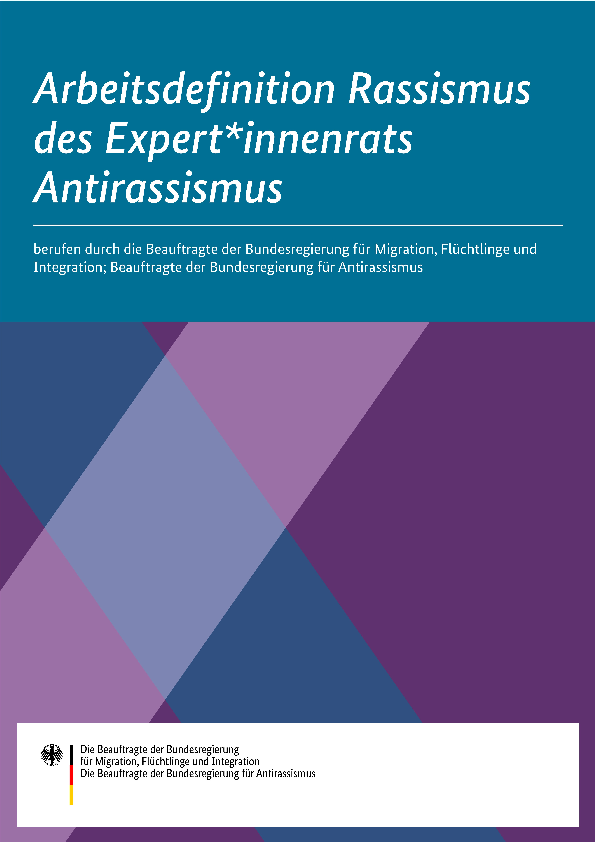
We draw, among other sources, on the working definition of racism developed by the Expert Group on Anti-Racism, appointed by the Federal Government Commissioner for Migration, Refugees, and Integration; Federal Government Commissioner for Anti-Racism and IDA NRW.
A Gap and the Beginning of a Journey
We acknowledge that, as a university, we are still at the very beginning of the process of becoming an institution that critically examines racism. This gap is reflected, among other things, in a lack of representation and visibility of diverse perspectives, as well as in the dominance of Eurocentric narratives in our curricula. The process of “decolonizing academia”—that is, the critical reflection on and transformation of existing bodies of knowledge in teaching and research—requires the active participation of all members of the university community. It is a collective task that requires reflection, self-criticism, and action. On this page, we have compiled a selection of books, articles, and resources for you as university members that offer both theoretical knowledge and practical ways to take action. We invite you to learn more and actively participate in shaping a university culture that challenges racism.
As part of the BIG project, we regularly offer programs and workshops designed to encourage engagement with this key topic. You can find the current events and workshops here: BIG
New Working Definition of Racism by the Expert Council on Anti-Racism
In 2023, the Expert Council on Anti-Racism of the former Federal Government was established. It consisted of twelve members from academia, government, and the field. In the meantime, the council presented a guide for government agencies to Reem Alabali-Radovan, the now-former Federal Government Commissioner for Anti-Racism, in Berlin. The work of the Expert Council is thus concluded for the time being. Work on the issue continues within the ministry. Yasemin Karakaşoğlu, a professor at the University of Bremen, was a member of the council and helped draft the paper. The up-to-date and comprehensive definition of racism is specifically tailored to administrative action. In doing so, the council creates a foundation for sustainable anti-racism strategies in public institutions. The definition is primarily aimed at employees in administration, politics, and the field to foster a shared understanding and enable effective measures.
The Expert Council emphasizes that government institutions, in particular, must be pioneers in the fight against racism. The developed definition is intended to help administrations at the federal, state, and local levels better identify and systematically dismantle racist structures. This includes, in particular, reviewing and reforming institutional routines, processes, and procedures that may unconsciously perpetuate racial discrimination.
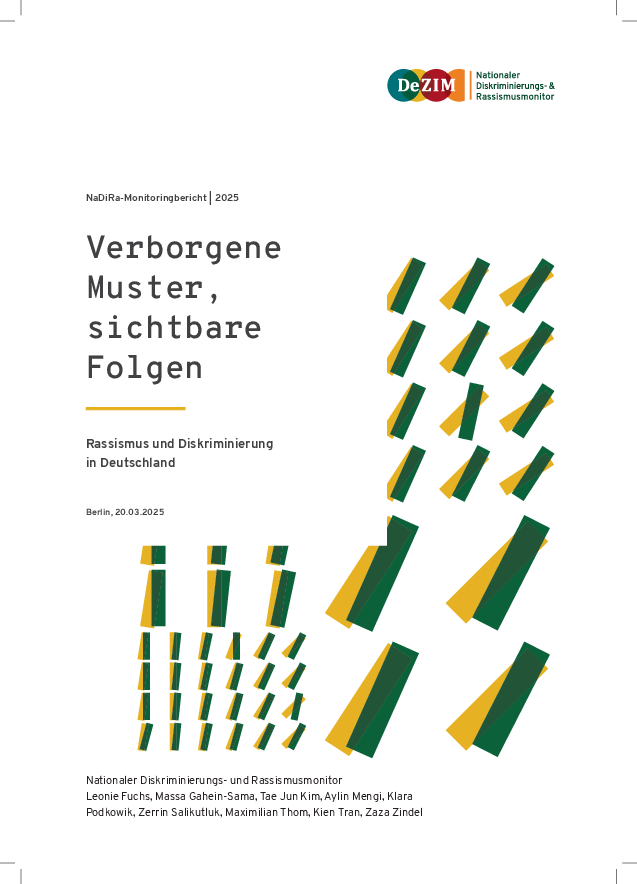
NaDiRa Monitoring Report
The 2025 Monitoring Report by the National Discrimination and Racism Monitor (NaDiRa), “Hidden Patterns, Visible Consequences. Racism and Discrimination in Germany,” highlights the unequal distribution of experiences of discrimination in German society: More than half of people perceived as racialized (54%) report having experienced discrimination at least once a month in 2024. Among people not perceived as racialized, the proportion is 32%. The report examines three central questions:
- How have racist attitudes developed in German society?
- What experiences do people who are racially profiled have in their everyday lives?
- What are the effects of experiencing discrimination?
The results show that racist attitudes are widespread. Those who are regularly discriminated against are more likely to suffer from psychological stress and report symptoms of depression and anxiety disorders. Furthermore, trust in state institutions is declining—especially among people with repeated experiences of discrimination.
You can download the full report as a file by clicking on the PDF NaDiRa Monitoring Report 2025
bukof Recommendations for Gender Equality Advocates on Addressing Anti-Muslim Racism at Universities
This comprehensive paper offers concrete recommendations for gender equality advocates on addressing religious diversity, with a focus on Muslim women and anti-Muslim racism. Using specific examples, the paper demonstrates how gender equality work can be approached from an intersectional perspective in this context.
The paper was authored by the bukof Working Group on Muslim Women at German Universities and can be found here as a PDF file: bukof Recommendations for Action.
Contact
Nele Kuhn
Email: nele.kuhn@vw.uni-bremen.de
Phone: (0421) 218 - 60302
Contact Points
- ADE – Arbeitsstelle gegen Diskriminierung und Gewalt – Expertise und Konfliktberatung, Universität Bremen
- ADA - Antidiskriminierung in der Arbeitswelt
- Arbeitnehmerkammer Bremen
- DiBS! Diskriminierungsschutz und Beratung für Schüler*innen
- Die Integrationsbeauftragte des Landes Bremen
- Faire Integration
- soliport - Betroffene rechter, rassistischer, antisemitischer Gewalt solidarisch beraten und unterstützen
Guidelines

Resources, Literature, and Studies
Racism & Critical Whiteness
- Aikins, M. A., Bremberger T., Aikins, J. K., Gyamerah, D.,& Yildirim-Caliman, D. (2021). Afrozensus 2020: Perspektiven, Anti-Schwarze Rassismuserfahrungen und Engagement Schwarzer, afroamerikanischer und afrodiasporischer Menschen in Deutschland. Berlin. Abrufbar unter: https://afrozensus.de/reports/2020/#start
- Amjahid, M. (2021). Der weiße Fleck. Eine Anleitung zu antirassistischem Denken. München: Piper.
- Antirassismus Hyatt, M. (2015). „Weißsein als Privileg”. Abrufbar unter: https://www.deutschlandfunk.de/critical-whiteness-weisssein-als-privileg-100.html
- El-Mafaalani, A. (2021). Wozu Rassismus? Von der Erfindung der Menschenrassen bis zum rassismuskritischen Widerstand. Kiepenhauer & Witsch: Köln.
- Kerner, I. (2013). „Critical Whiteness Studies: Potentiale und Grenzen eines wissenspolitischen Projekts”. In: Feministische Studien, Jg. 31, Heft 2, S. 278-293. URL: https://doi.org/10.1515/fs-2013-0209
- Malik, M. (2022): „Wer lernt (was) auf wessen Kosten?”. In: Akbaba, Y., Buchner, T., Heinemann, A.M., Pokitsch, D., Thoma, N. (Hg.): Lehren und Lernen in Differenzverhältnissen. Pädagogische Professionalität und Migrationsdiskurse. Springer VS, Wiesbaden, S. 25-44, URL: https://doi.org/10.1007/978-3-658-37328-3_2
- Ogette, T. (2017). exit RACISM rassismuskritisch denken lernen (9. Aufl.). Unrast Verlag: Münster.
- Perinelli, M. (2019). „Triggerwarnung! Critical Whiteness und das Ende antirassistischer Bewegung”. In: Phase 2. Jg. 51, Heft 1, Abrufbar unter: https://www.phase-zwei.org/hefte/artikel/triggerwarnung-160
Books: University Context
- Ahmed, S. (2012). On being included: Racism and diversity in institutional life. Duke University Press.
- Fereidooni, K., & Eleyth, N. (o. D.). Was tun gegen Rassismus an Universitäten? [Interview].
- Heitzmann, D., & Houda, K. (Hrsg.). (2024). Rassismus an Hochschulen: Analyse – Kritik – Intervention. Beltz Juventa.
- Kessé, E. N. (2023). Eingeschrieben: Zeichen setzen gegen Rassismus an deutschen Hochschulen. transcript Verlag.
- Snow, N. (o. D.). The beast in the belly. In Heimatkunde. Heinrich-Böll-Stiftung.
- Universität Bielefeld. (o. D.). Rassismuskritik der Universität [Podcast-Folge mit Paul Mecheril].
- Universität Göttingen. (o. D.). Die gerechte Hochschule: Visionen einer guten und diversen Wissenschaft [Podcast-Miniserie].
- Hasenjürgen, B. (2021) ‘Rechte Verhältnisse in Hochschule und Gesellschaft: Rassismus, Rechtspopulismus und extreme Rechte zum Thema machen’, in: Rechte Verhältnisse in Hochschule und Gesellschaft, pp. 271–290.
- Thompson, V.E. (2001) ‘Rassismus an der Hochschule: Intersektionale Verstrickungen und Möglichkeiten des Abolitionismus’, in: Kultur und soziale Praxis; Bildung. Macht. Diversität, Bielefeld: transcript Verlag.
- Polat, A. and Joseph-Magwood, A. (2024) ‘Rassismus und Diskriminierungsverhältnisse an Hochschulen. Ergebnisse einer Erhebung unter Studierenden und Mitarbeitenden’, Migration und soziale Arbeit, 46(1), pp. 48–55.
- Bourabain, D. (2021). Everyday sexism and racism in the ivory tower: The experiences of early career researchers on the intersection of gender and ethnicity in the academic workplace. Gender, Work and Organization, 28(1), 248–267. https://doi.org/10.1111/gwao.12549
Studies
- Afrozensus
- NaDiRa Studie „Wer bleibt“? https://www.rassismusmonitor.de/detail/2024-3-7/wer-bleibt/
Guidelines
- IDA-NRW: beyond the basics - Erfahrungen, Impulse und Strategien gegen institutionellen Rassimus: https://www.ida-nrw.de/fileadmin/user_upload/Aktuelles/Dokumentation_Fachtag_beyond_the_basics__final_.pdf
- IDA_NRW: “Humor” & Rassismuskritik am Arbeitsplatz: https://www.ida-nrw.de/fileadmin/user_upload/Aktuelles/blau_gesamt.pdf
- IDA-NRW: Verletzungen & Rassismuskritik am Arbeitsplatz: https://www.ida-nrw.de/fileadmin/user_upload/Aktuelles/gruen_gesamt.pdf
- IDA-NRW: Einstellungsverfahren & Rassismuskritik am Arbeitsplatz: https://www.ida-nrw.de/fileadmin/user_upload/Aktuelles/lila_gesamt.pdf
- IDA-NRW: Organistationsstruktur & Rassismuskritik am Arbeitsplatz: https://www.ida-nrw.de/fileadmin/user_upload/Aktuelles/gelb_gesamt.pdf