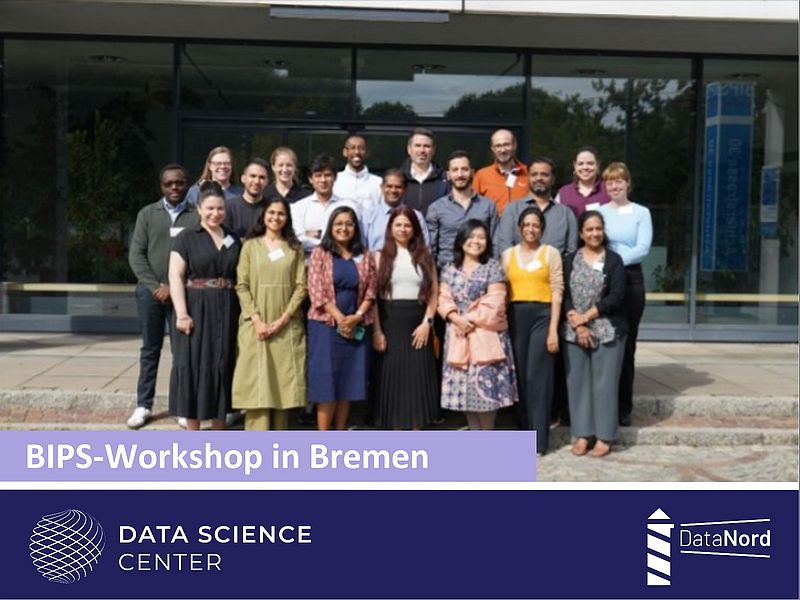
On September 10 and 11, the international workshop "Interdisciplinary Geospatial Measurement and Analytical Methods for Global Public Health Research and Policy" took place at the Leibniz Institute for Prevention Research and Epidemiology (BIPS) in Bremen. Funded by the German Alliance for Global Health Research (GLOHRA), the event was aimed at researchers from the fields of public health, epidemiology, environmental and climate sciences, geospatial data processing, and policy advice.
In lectures and interactive working sessions, the participants addressed the question of how satellite-based and other geospatial data can specifically support more equitable global health research and policy. In addition to identifying current methodological and practical challenges, concrete solutions were developed and practical research processes were simulated. The focus was on topics such as the assessment of environmental impacts, data quality and uncertainties, data protection, reproducibility and global inequalities in data availability.
Open Geospatial Tools for Reproducible Research
As a representative of DataNord, Annika Nolte enriched the workshop with her presentation on "Open Geospatial Tools and Datasets for Reproducible Environmental Exposure Assessment." She provided an overview of how health-relevant exposure variables can be derived from raw Earth observation data. She also presented practical approaches for finding and processing open geospatial data using open-source tools and reproducible GIS workflows. A key focus of her presentation was on data quality requirements: While Earth observation data provide valuable information about environmental factors such as air pollution, satellite measurements generally require thorough processing before they can be interpreted epidemiologically. Annika Nolte emphasized that freely accessible datasets do not automatically meet the FAIR criteria (Findable, Accessible, Interoperable, Reusable) or are not necessarily suitable for specific research questions. Researchers must therefore take into account the origin of the data, the underlying assumptions, the spatial and temporal resolutions and the available validations, and document the processing steps transparently so that data and results can be selected and interpreted on a sound basis and passed on in a way that is traceable and, as far as possible, reusable.
Further Links:
If you have any questions, please contact:
Dr. Annika Nolte
DSC Data Scientist
Phone: +49 (421) 218 59856
Mail: anolteprotect me ?!uni-bremenprotect me ?!.de