

Field of work Organizational Psychology

News

New Publication in Scientometrics: Response on Shared First Authorship

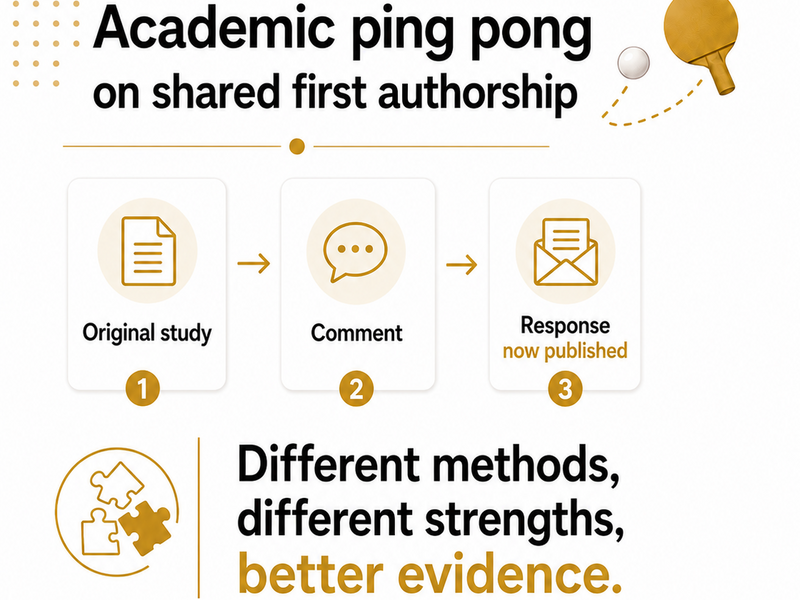
Dr. Julian Decius has published a response article together with Dr. Miriam Schilbach (Maastricht University) addressing the comment by Dr. Samuel Bruton and Dr. Mohammad Hosseini on their study of shared first authorship.

Dr. Julian Decius has published a response article together with Dr. Miriam Schilbach (Maastricht University) addressing the comment by Dr. Samuel Bruton and Dr. Mohammad Hosseini on their study of shared first authorship. The article, titled “Broadening how we study shared authorship: response to Bruton and Hosseini,” appeared in Scientometrics.

The academic exchange centers on how shared first authorship is evaluated in academic career and selection decisions. In their original experimental vignette study, Decius and Schilbach examined whether shared first authorship affects the attribution of academic credit. The findings showed that first authors and shared first authors were evaluated similarly.

In their comment, Bruton and Hosseini discussed important limitations of vignette studies and pointed out that real-world selection decisions are considerably more complex. In their response, Decius and Schilbach take up these concerns while also emphasizing the value of experimental designs: they can help identify specific evaluation mechanisms that are difficult to isolate in practice. The authors further call for a broader evidence base for the fair and transparent evaluation of shared authorship, including combinations of experiments, surveys, interviews, field studies, and career outcome analyses.

The response article is freely accessible here.


Artikelübersicht

People and topics

Photo of Dr. Julian Decius

Dr. Julian Decius

Contact:

WiWi1, Room A2390
Enrique-Schmidt-Str. 1
28359 Bremen


Phone: +49 421 218 66590
E-mail:
julian.deciusprotect me ?!uni-bremenprotect me ?!.de

find out more: Dr. Julian Decius
Joint working discussion.

Learning processes over time

This topic focuses on how (informal) learning behavior in organizations changes over days, weeks, and months. Moreover, we analyze the dynamics of work-related learning and how learning trajectories differ between employees.

A model of an assembly hall with the inscription “Technikstation”.

Designing work contexts

The goal of this thematic focus is to examine conducive conditions for work-related learning, employability, and organizational development, both by managers (e.g., shaping learning culture) and by employees (e.g., job crafting).

One person operates a tablet.

New Work requires New Learning

This topic is dedicated to the question of how employees in dynamic work environments can be empowered to learn "what they really, really want" in a self-directed way. The "Learning Opportunities Perception Potential", which helps employees to grasp learning opportunities, is considered crucial here.