Just four months after the cluster’s launch, researchers from the “Wheels” and “Baselines” task forces presented their current research status within the cluster to highlight areas of overlap and identify common challenges.
The focus was on materials, wheel design, processes, and process chains. The goal of the Micro Mission was to identify early on how closely the individual research fields depend on one another and which gaps need to be closed to achieve the demonstrator’s goal. By 2031, a functional rover wheel is to be produced from Martian resources and under Mars-like conditions.
The event combined presentations with interactive workstations and highlighted how important interdisciplinary exchange is for the cluster. Many questions can only be answered collaboratively, as decisions in one area have direct implications for other research fields. Hall 2 of the ZARM quickly filled with a lively buzz of voices: as participants engaged in intense technical exchanges, discussions became so dynamic that moving on to the next station wasn’t always easy, since conversations and joint deliberations were still in full swing.
One example of these interdependencies is the rover wheel itself. Questions regarding size, weight, or geometry are directly linked to material properties and process chains, which in turn have a decisive influence on the design of the rover wheel. In the course of the discussions, a material that had previously been viewed more as a supplementary component came into sharper focus: PHA (polyhydroxyalkanoates), so called biodegradable bioplastics. Through this interdisciplinary exchange, the idea emerged to use PHA in the future not just as an additive, but as a standard material in multiple process steps.
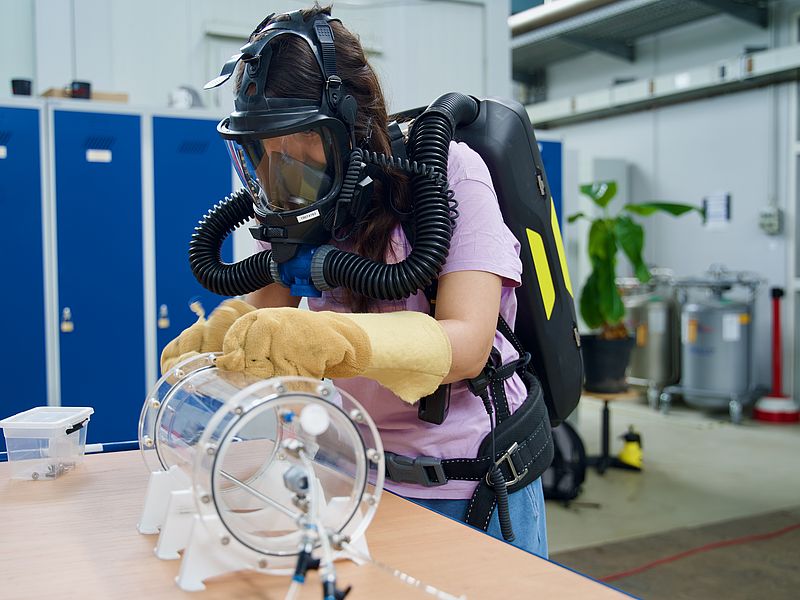
The work of humans under Martian conditions was also discussed. Protective suits and oxygen systems restrict mobility, the field of vision, and fine motor skills. This results in specific requirements for components and production processes: for example, components must be large enough to be safely grasped even while wearing gloves. The participants were able to test this for themselves—with limited vision due to the oxygen mask, a heavy backpack for the breathing apparatus, and thick gloves, they had to disassemble and reassemble components.
The first Micro Mission thus not only highlighted interdependencies in terms of content but also forged new connections between research areas. At the same time, necessary pre- and post-processes were identified, and new perspectives on existing approaches were opened up.
The event was organized and led by the joint leadership of the demonstrator: Christiane Heinicke, Scientific Coordinator of the cluster, and Cyprien Verseux, Head of the Applied Astrobiology Working Group at ZARM.
The regular micro-missions are a central component of the cluster ‘s journey toward Martian Mindset Month 2028, during which key research approaches will be systematically brought together and tested under Mars-like conditions.