
Anti-discrimination Policy
Putting the anti-discrimination policy into practice!
In April 2024, the Academic Senate of the University of Bremen adopted an university anti-discrimination policy. The anti-discrimination brochure complements the University of Bremen’s Anti-Discrimination Policy. As the policy is based on legal regulations, questions may arise as of how to put it into practice. This brochure explains the university‘s policy and thus facilitates its application.
A Culture of Anti-Discrimination Needs Everyone!
Every one of us has a responsibility to reduce discrimination in everyday university life and to take a stand against discriminatory behavior. But what does that mean in practice? How can we react appropriately and avoid discrimination wherever possible? What can you do if you yourself are discriminated against, witness discrimination, or are accused of discriminating against someone else? What support does the university executive board provide? The following pages will provide you with answers to all these questions.
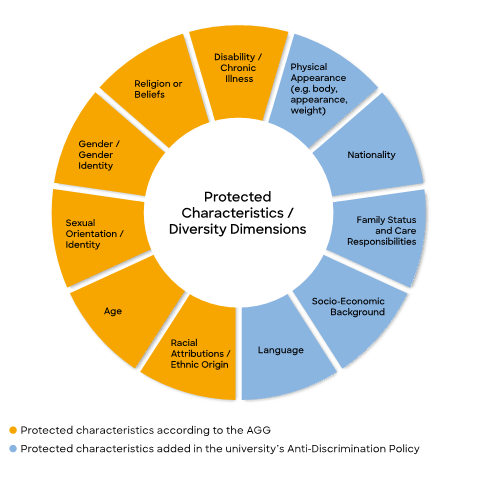
What Are Protected Characteristics?
The term discrimination is limited to less favorable treatment based on actual or attributed diversity characteristics: In accordance with the AGG, the university considers gender (including pregnancy and parenthood)/gender identity, sexual identity, racial attributions or ethnic origin, religion and beliefs, age, and disability/chronic illness to be protected characteristics. In addition, the university has decided to add the following protected characteristics: physical appearance, socio-economic background, language, nationality, and family status (e.g. marital status or care responsibilities). Discrimination and less favorable treatment on the basis of any of these characteristics are therefore prohibited at the University of Bremen.
What can I do if I have experienced discrimination?
You have experienced discrimination in a university setting and feel that it is affecting your studies /work? What do you need the most right now? Rest, some space, understanding, talking to someone, practical solutions?
Take your feelings seriously and trust your perception.
Experiencing or dealing with discrimination is often characterized by a multitude of painful and sometimes contradictory feelings and reactions: Anger, rage, powerlessness, shame, self-doubt, hurt, insecurity, humiliation, sadness, helplessness, speechlessness, resistance, and/or withdrawal.
Write down the incidents (memory log) so to help you remember the situation(s) and circumstances in detail later. This allows you to decide without pressure whether and when you want to take action.
Talk to people you trust. However, be aware that supervisors, deans, researchers,and teaching staff must in principle take action if they learn of incidents of discrimination and are therefore not confidential contact persons.The university’s policy stipulates that these persons are responsible for protecting against discrimination and following up on any indications of discrimination. If you are unsure whether you want to take action, please contact persons of trust in your social and work environment or the designated contact person and counseling services at the university, who will offer you confidential conversations.
Consult a professional service or counselor if you want to talk about yourexperience. Here you can clarify in a safe setting what you can do next and what support you can get. You can also seek advice if you are unsure whether what you have experienced constitutes as discrimination.
It can be empowering to talk to people who have experienced similar things and to develop strategies for dealing with discrimination together. Empowerment workshops at the University of Bremen and beyond, e.g. for people who have experienced racism, for queer and for trans* persons, also provide a suitable setting and space for this. If you have any questions about services and how to report needs, you are welcome to get in touch with the support persons and services listed on the right.
In addition, you can contact the ADE to find out about possible early interventions and/or file an official complaint.
What can I do if I have observed discrimination?
The University of Bremen is actively committed to making discrimination visible and countering it, because discrimination concerns everyone. Together, we can contribute to creating a respectful and open climate in our learning, teaching, and work environments.
What you can do:
- Speak up about discriminatory remarks – whether in meetings, chats, working groups, seminars, or other university contexts.
- If a person is directly affected, talk to them and offer them your support.
- Keep a written record of important situations. This will help you remember details later and support those affected in taking further steps.
- Take advantage of the counseling services offered by the University of Bremen if you are unsure how to act in a specific situation.
What can I do if I have behaved in a discriminatory manner?
For many people, discrimination is an unsettling or even threatening term. When you receive feedback about discriminatory behavior, it can quickly be perceived as a reproach or accusation. People often react defensively, by downplaying the issue, or with emotional counter-reactions.
Therefore, it is important to remember the following:
- In cases of discrimination, the primary focus is not on intent, but on the impact of a behavior.
- Therefore, take feedback and criticism seriously. Even if it may be challenging at first, pause briefly and reflect on your specific statement or action without hastily judging yourself or others or adopting a defensive stance.
- Reflect on your behavior and language, particularly with regard to the potential impact on others.
- If necessary, ask for an explanation of the situation from your counterpart’s perspective so that you can better understand the criticism and derive constructive steps.
- Take advantage of the opportunity for early conflict intervention if your counterpart offers this as a means of reaching an understanding.
- View a potential complaint procedure as an opportunity for clarification and as a legitimate right of those affected. You, too, have the opportunity to present your perspective and involve a trusted person.
- Apologize to the person who feels discriminated against by your behavior, even if you did not intend to discriminate.
- Talk to others who are also interested in becoming more aware of discrimination. Conscious reflection offers the chance to better understand and develop your own perspectives and thought patterns.
- If necessary, make use of the available contact and counseling services. These will help you better understand the impact of your actions and communication and deal with it constructively.
The responsibility of teaching staff and supervisors
“Members of the university who carry out educational, qualification, and management tasks in teaching, research, and administration (...) bear a particular responsibility and obligation towards the (...) persons to be protected,” states the policy.
Accordingly, everyone is required to actively support cooperation that is sensitive to discrimination and a respectful approach to diversity within their respective areas of responsibility. This applies to professors and dean's offices, as well as to staff with personnel and management responsibilities and teaching staff members. Together, they help bring the University of Bremen’s anti-discrimination policy to life on a daily basis.
- Contribute to creating an environment within your area of responsibility that is sensitive to discrimination and supports a climate where criticism and/or conflicts can be addressed constructively.
- Share this brochure. By doing so, you are helping to inform people about their rights and obligations regarding protection against discrimination.
- If you receive reports of discrimination, it is important to take them seriously and investigate them. If necessary, use the ADE’s counseling services to jointly reflect on and clarify your assessment and your options for action in a specific situation.
- If an incident is assessed and found to be discriminatory, appropriate measures must be taken to protect the affected person and to prevent further discrimination. Which measures are appropriate, reasonable, and necessary depends on the specific incident.
- To support you and coordinate measures, the policy recommends involving your immediate supervisor. For professors, this could be the dean's office, for example.
- If disciplinary or employment-related measures are likely, it is advisable to involve the Human Resources Office early on, or the Legal Office if measures involve students.
- As a general rule, however, the group of people informed about an incident should be kept as small as possible to protect all parties involved.
- If an affected person approaches you confidentially and is still unsure how to proceed, please recommend confidential counseling. At the same time, clearly explain that you are required to investigate reports of discrimination and take appropriate action.
- Take advantage of opportunities for further training. The university management has expanded its offerings in the areas of anti-discrimination and professional development and such training can help you further strengthen your confidence in your role.
- Familiarize yourself with the various forms of discrimination and take the time to reflect on your own perspectives and potential biases.
Services and Support
Advice and Counseling on Discrimination:
ADE – Anti-Discrimination and Conflict Management Office – Advice and Counseling
Mail: adeprotect me ?!uni-bremenprotect me ?!.de
Phone: +49 421 218 – 60170
Phone consultation hours: Tuesday 10 to 11:30 a.m., Thursday 4 to 5:30 p.m. Alternatively, you can email us to schedule a counseling appointment.
www.uni-bremen.de/en/ade
Complaints Offices:
Discrimination Complaints Office for Students
Legal Office (Unit 06)
VWG building, P.O. Box 330440, 28334 Bremen
www.uni-bremen.de/en/rechtsstelle
Discrimination Complaints Office for Employees
Human Resources Department (Administrative Department 2)
P.O. Box 330440, 28334 Bremen
www.uni-bremen.de/dezernat2