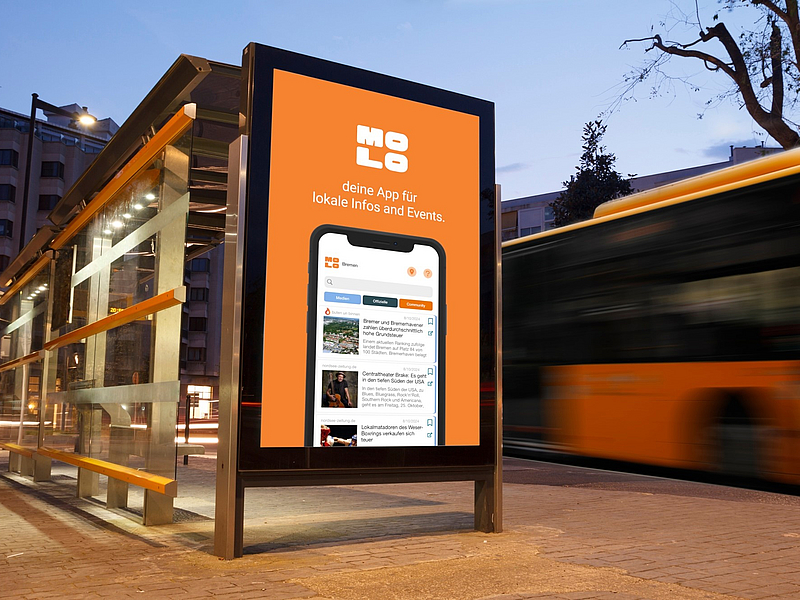
This free of charge, ad-free, and registration-free community app aggregates local news and is now available across Germany.
molo was developed by the University of Bremen, the Leibniz Institute for Media Research | Hans Bredow Institute (HBI), and the University of Leipzig in close collaboration with citizens and local stakeholders. The goal was to create a platform that would strengthen the local public sphere in the long term. Although federal funding has ended as planned, the platform will remain operational. The concept has evolved beyond the original research project.
“molo is a breakthrough that frees us from our dependence on big tech platforms that exploit our data,” says Prof. Dr. Andreas Hepp, principal investigator at ZeMKI. “Together with all stakeholders, we’ve shown that a local and regional information platform can operate inclusively and efficiently while fostering direct, meaningful connections with the community.”
The local public sphere is under strain. According to the latest news consumption study by the HBI Reuters Institute Digital News Report 2026 (results for Germany), 18 percent of internet users now rely on social media as their primary news source. Local news and community information are increasingly getting lost in the digital noise.
“The local public sphere no longer emerges organically,” says Prof. Dr. Wiebke Loosen, principal investigator at HBI. “It now depends on infrastructure. News consumption is concentrated on just a few commercial platforms, while local events are scattered across an ever-growing number of individual channels.”
This means that local clubs, grassroots initiatives, arts and culture organizations, and municipalities must manage an ever-expanding digital presence, including maintaining websites, municipal calendars, newsletters, portals, and social media accounts just to stay visible. This is often financially and logistically unsustainable, especially for volunteer-run organizations.
“Local visibility then depends on who has the resources to manage it,” Loosen explains. “A public-interest infrastructure, however, brings the local public information together in one accessible place, without being optimized for reach or advertising. molo shows what that can look like.”
molo Offers an Alternative to Dependence on Major Tech Platforms
It starts where local information is already being created: on the websites of local clubs, initiatives, municipalities, cultural institutions, and media outlets. molo’s content hub automatically imports and aggregates events and news items into one centralized, easy-to-navigate space. The platform’s AI, developed specifically for this purpose, organizes content efficiently but does not generate it. Designed with data privacy in mind, the system operates in a resource-efficient way and meets the requirements of the EU AI Act. When users open a post through the molo app, they are directed straight to the original source, ensuring transparency and supporting local publishers.
The concept has proven itself in everyday life. From Greifswald to Reutlingen, molo now processes thousands of news items daily from hundreds of sources and media partners across Germany. Over 6,000 people use the app, and more than 300,000 events have been published since its launch. In addition to press offices, clubs, and cultural institutions, media outlets contribute content, including Tagesschau, taz, Weser-Kurier, and Landeszeitung (Lüneburg). Users can specify their preferred location and radius for news and events.
The Funding Goal Has Been Achieved
From March 2023 to August 2026, the molo.news project received support from the VIP+ program of the Federal Ministry of Education and Research (now the Federal Ministry of Research, Technology, and Space). The goal was to develop an operational model that could sustain itself beyond project funding, and to test it in large, medium, and small cities across Germany. What began in 2017 as the “Tinder the City” research project has now become permanent infrastructure for the local public – ad-free, community-driven, and powered by existing content by local clubs, government agencies, and newsrooms.
ZeMKI and HBI Continue their Close Collaboration
As an independent platform for local information and community events, molo has proven its value and will therefore continue to be developed and operated by the University of Bremen. Research is ongoing. ZeMKI and HBI are jointly analyzing the insights gained from over three and a half years of real-world operation, shedding light on how the local public sphere functions today and how it can be strengthened. Stakeholders and media outlets with local content can join at any time. A simple request with a link to the source is all it takes to connect. In the future, the technology behind this public-interest platform will also be available as a standalone solution for individual municipalities, regional networks, and institutions. The team is offering the platform’s core principles as a customizable infrastructure under the name molo infrastructures, a toolkit for building transparent, community-centered digital spaces that put local voices first. Discussions are already underway.
Further Information:
www.molo.news / www.moloinfrastructures.com
About the Project Partners:
ZeMKI: The Centre for Media, Communication and Information Research (ZeMKI) at the University of Bremen studies changes in media, communication, and the public sphere. It developed the molo app and coordinates the collaborative project (Prof. Dr. Andreas Hepp).
HBI: The Leibniz Institute for Media Research | Hans Bredow Institute (HBI) in Hamburg studies media transformation and the associated changes in public communication. (The principal investigator in the molo network is Prof. Dr. Wiebke Loosen.)
University of Leipzig: The Chair of Media and Communication Studies (Prof. Dr. Christian Pentzold) conducts research on digital communication and participation, and is responsible for pilot testing within the molo network in Leipzig and the surrounding area.
molo infrastructures: molo infrastructures is the technology transfer initiative of the molo team at the University of Bremen: molo’s technology and platform principles are offered as a science-based service for municipalities, consortia, and institutions.
For questions, please contact:
Alex Krause, ZeMKI, University of Bremen
Phone: +49 421 218-67699
Email: jakrauseprotect me ?!uni-bremenprotect me ?!.de or kontaktprotect me ?!moloprotect me ?!.news