
![[Translate to English:] Zur Startseite des Fachgebiets Umweltverfahrenstechnik](/fileadmin/user_upload/fachbereiche/fb4/uvt/LOGO/UVT-Logo-Webseite.png)
Bioplastic Production on Mars using Microbial Electrosynthesis (MES)
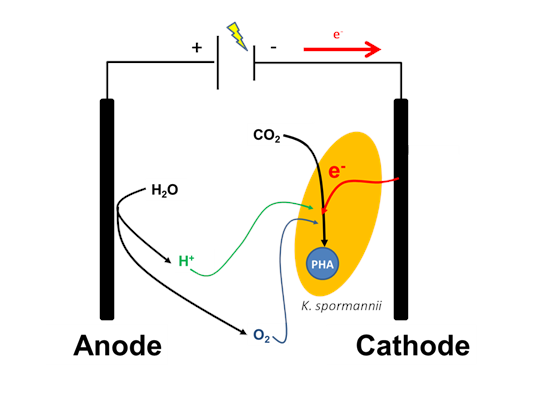
This project aims to develop a basis for bioproduction processes on Mars that rely on the planet's natural resources, in order to increase the sustainability of future settlements. Furthermore, we expect to gain important insights and impulses for more resource-efficient post-fossil technologies and concepts here on Earth.
This PhD project is part of the Cluster of Excellence "The Martian Mindset: A Scarcity-Driven Engineering Paradigm" at the University of Bremen, funded by the German Research Foundation from 2026 to 2032. The cluster adopts extreme Martian boundary conditions (without fossil fuels or extensive water resources and surrounded by a thin CO₂ atmosphere) as a new mindset to develop new technologies for sustainable production.
Within this framework, this project focuses on Microbial Electrochemical Systems ( MES) using the electroactive bacterium Kyrpidia spormannii to produce biodegradable bioplastics (PHA) directly from CO₂ and electricity, which can be sourced from the Martian atmosphere and solar energy. The research investigates how nutrient limitation conditions, electrode materials, and electrochemical cell design influence PHA productivity and polymer characteristics. By optimizing the balance between microbial growth and bioplastic accumulation phases, we aim to maximize production efficiency while characterizing the properties of the resulting polymers. A comprehensive model will be developed to describe the productivity, efficiency, and cost of the system, enabling comparison with alternative synthesis routes. This work establishes the scientific foundations for a novel approach to sustainable material production on Mars, demonstrating how electricity and atmospheric CO₂ can be converted into valuable plastic materials without requiring organic feedstocks – which will be also relevant for sustainable production on Earth.