INTERGON
Project description
INTERGON is funded by the DFG Walter Benjamin Programme, which supports early-career postdoctoral researchers in pursuing independent research projects and developing their own scientific profile. Under this programme, INTERGON focuses on advancing aqueous zinc-ion battery technology through innovative interfacial engineering strategies.
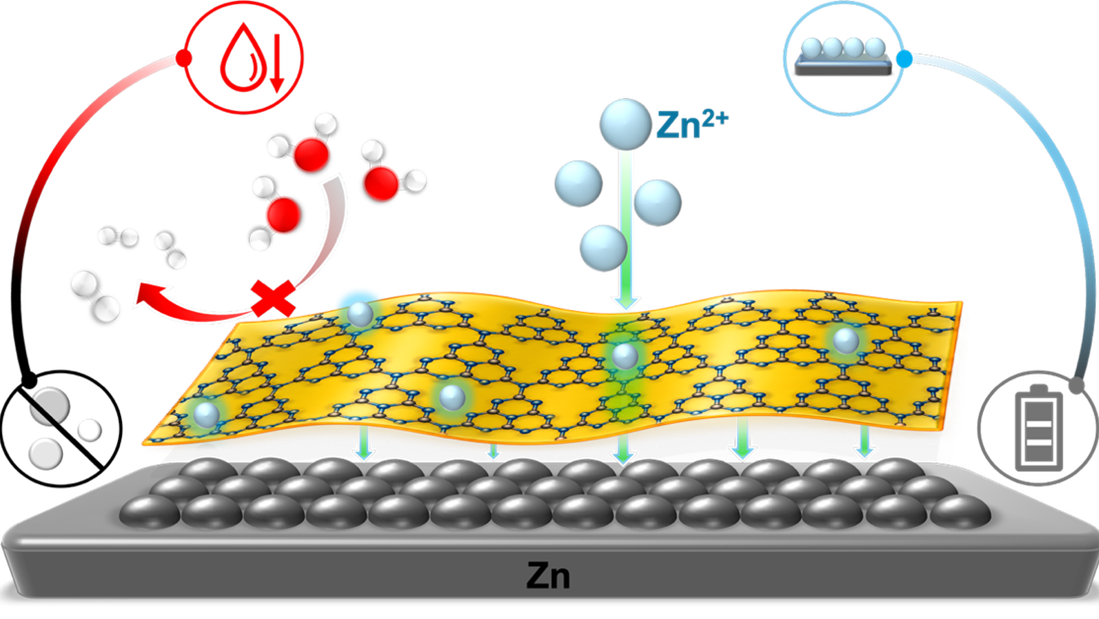
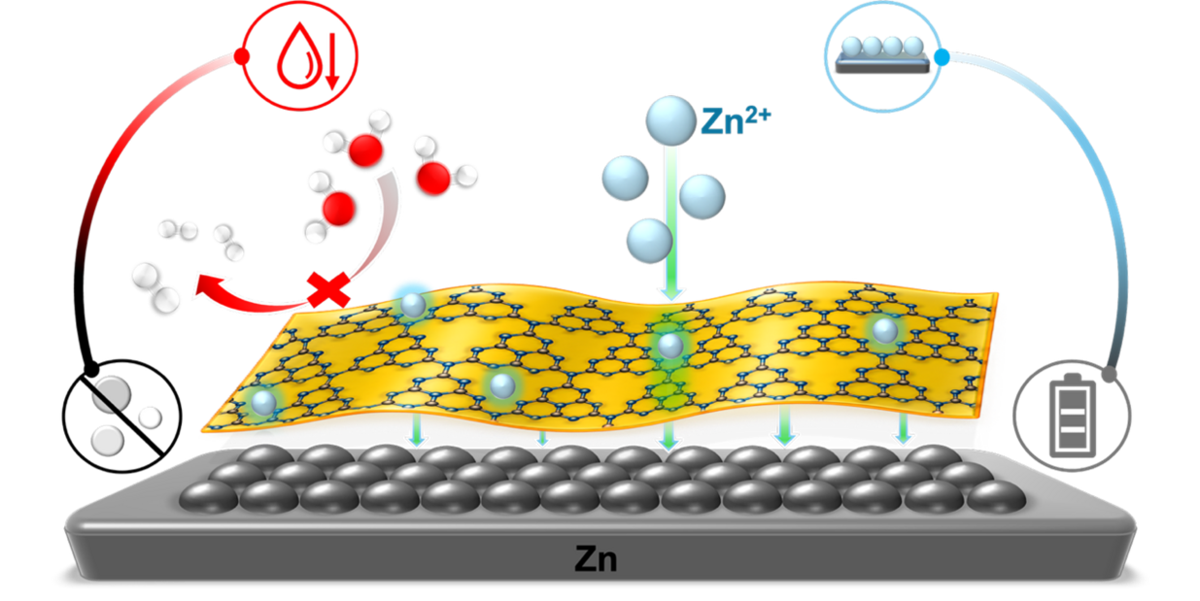
Aqueous zinc-ion batteries (AZIBs) are considered highly promising alternatives to lithium- and sodium-ion systems for stationary energy storage due to their low cost, abundance, and high intrinsic safety. However, the instability of the metallic zinc anode due to dendrite formation, hydrogen evolution reaction (HER), and by-product accumulation remains the major obstacle to their large-scale application. These issues reduce Coulombic efficiency, shorten cycle life, and may lead to safety concerns, necessitating the urgent development of simple, effective, and low-cost coating strategies for Zn anodes. Graphitic carbon nitride (gCN), a polymeric semiconductor, has a layered, nitrogen-rich framework and offers high thermal and chemical stability, versatile tunability, and effective anchoring sites for metals. Previous studies have shown that gCN coatings can increase Zn deposition uniformity and suppress dendrite growth. However, their full potential in HER suppression has not yet been fully explored, especially with respect to the incorporation of polar sites and modulation of electronic structure. The proposed work focuses on the rational design of oxygen and phosphorus co-doped gCN nanosheets (O,P-gCNNSs) as functional interfacial layers to stabilize Zn anodes. Oxygen incorporation creates polar oxygen-containing sites that preferentially bind Zn²⁺ ions, thereby inhibiting water adsorption and suppressing HER. With phosphorus doping, interlayer spacing is enlarged, Zn²⁺ diffusion is facilitated, and new conduction band edge states emerge, which increase electrical conductivity and direct electron flow towards Zn²⁺ nucleation rather than proton reduction. The synergistic effect of O and P co-doping is expected to reduce Zn nucleation overpotentials, suppress hydrogen evolution, and ensure homogeneous Zn accumulation and dissolution. This project will focus on the synthesis and characterization of O,P-gCNNSs, their integration as a coating layer on Zn anodes, and the systematic evaluation of their electrochemical performance in AZIBs via methods such as galvanostatic cycling, EIS, and LSV. Additionally, operando and post-cycling analyses, including DEMS and post-mortem structural studies, will be conducted to optimize electrode stability. A comprehensive set of advanced analytical techniques (e.g., XRD, FTIR, XPS, SEM) will be applied to establish robust correlations between the structural, interfacial, and electrochemical properties. Building on strong expertise in gCN modification and interfacial engineering, this research aims to fill a crucial gap in AZIB development, enabling dendrite-free, high-efficiency Zn anodes and paving the way for safe, long-life, and sustainable aqueous battery systems. Beyond AZIBs, the outcomes of this study may open new pathways for the advancement of sustainable energy storage technologies.