
M-BAT

Crystal structure of LMO, used as lithium-selective electrode material.
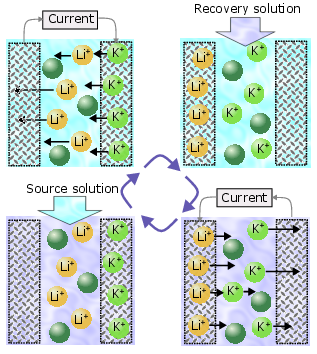
Principle of operation of the ion pump for the extraction of lithium from brines. Lithium is captured from the source solution by a selective electrode (made of LMO) and is then released to the "recovery solution". In the meanwhile, a counter-electrode (made of NiHCF) captures potassium ions from the recovery solution and releases them into the source solution.
Project description
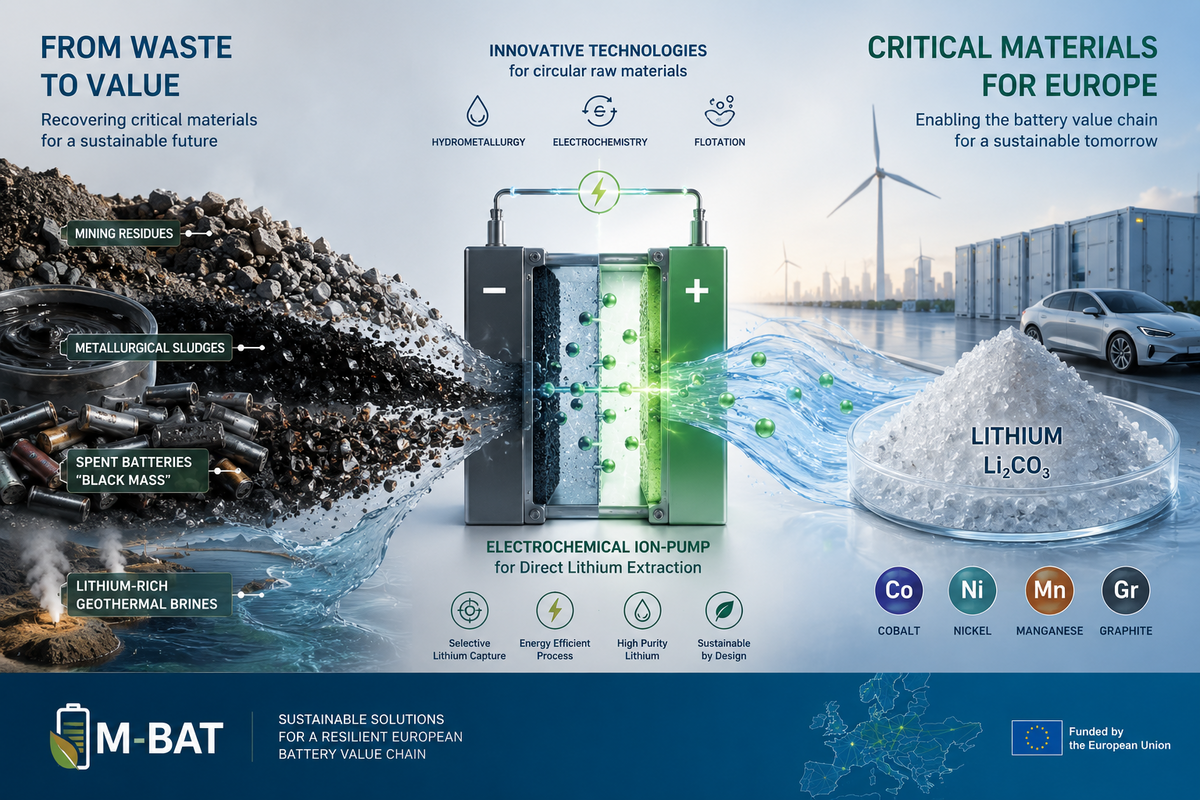
M-BAT is a European research and innovation initiative focused on strengthening Europe's independence in the battery raw materials supply chain by recovering critical materials from both primary and secondary resources available within Europe.
The project addresses the rapidly increasing demand for lithium, cobalt, nickel, manganese, and graphite driven by electric mobility and stationary energy storage systesm, while reducing reliance on imported raw materials that are often associated with geopolitical risks and environmental or social concerns. To achieve this, the consortium develops and demonstrates advanced recovery processes capable of extracting battery-grade materials from mining residues, metallurgical sludges, recycled battery “black mass”, and lithium-rich geothermal brines. The project combines hydrometallurgical, electrochemical, and flotation-based technologies to produce high-purity cobalt, nickel, and manganese sulfates, graphite, and lithium carbonate suitable for NMC811 cathodes and battery anodes.
A key contribution comes from ESECS, University of Bremen, which will be in charges of the development of the electrochemical ion-pump technology, aimed at the direct lithium extraction. In this process, lithium ions are selectively captured from the brines (various sources) within lithium-selective electrodes (e.g. based on manganese oxide) under an applied electric current and subsequently released into a separate recovery solution. This enables the generation of concentrated, high-purity lithium chloride streams under realistic operating conditions.
The project aims to validate all process routes in industriall relevant environments at TRL 6-7 while following safe and sustainable by design principles. Environmental performance, economic feasibility, and social impacts are evaluated alongside the technical development to support future industrial deployment across Europe. Demonstration activities include a pilot installation at the Cornish Lithium geothermal site designed to produce approximately 350 kg of lithium carbonate annually. The recovered materials will be tested in complete battery cells, including NMC811 cathodes and graphite anodes, to verify their suitability for next-generation battery applications and to provide a foundation for large-scale European implementation of sustainable battery material recovery technologies.
Collaborative partnerships
- FRAUNHOFER GESELLSCHAFT ZUR FORDERUNG DER ANGEWANDTEN FORSCHUNG EV Fraunhofer
- SIEC BADAWCZA LUKASIEWICZ - INSTYTUT METALI NIEZELAZNYCH IMN
- CACTUS INVESTIGACION CUALITATIVA Y COMUNICACION SOCIEDAD LIMITADA CACTUS INVESTIGACIÓN CUALITATIVA Y COMUNICACIÓN
- COBRE LAS CRUCES SA COBRE LAS CRUCES
- UNIVERSITAT POLITECNICA DE CATALUNYA UPC
- CETAQUA, CENTRO TECNOLOGICO DEL AGUA, FUNDACION PRIVADA CETAQUA
- CENTRO DE INVESTIGACION COOPERATIVA DE ENERGIAS ALTERNATIVAS FUNDACION, CIC ENERGIGUNE FUNDAZIOA CIC ENERGIGUNE
- CENTITVC - CENTRO DE NANOTECNOLOGIAE MATERIAIS TECNICOS FUNCIONAIS EINTELIGENTES CENTI
- UNIVERSITA DEGLI STUDI DI TORINO UNITO
- ASISTENCIAS TECNICAS CLAVE SL AT CLAVE
- NON-GOVERNMENTAL ORGANIZATION AGENCY OF EUROPEAN INNOVATIONS AEI
- BATTERY CLUSTER BAT ASSOCIACAO PORTUGUESA BATTERY CLUSTER
- ENERIS B&R SP ZOO ENERIS B&R
- KGHM POLSKA MIEDZ SA