The purpose of the two-day research stay is the collection and transfer of scientific data sets, including seismic profiles, petrophysical sediment properties, hydroacoustic data, and shallow gas indicators. The data will then be used to construct a 3D high-resolution Baffin Bay numerical model at the University of Bremen, in collaboration with Prof. Dr. Sverre Planke (University of Oslo).
Large-scale scientific 3D models of natural gas hydrate systems are currently only developed at MARUM (Center for Marine Environmental Sciences at the University of Bremen) and require both large amounts of digital data input and extensive computational resources. The model simulations and outputs advance gas hydrate research, providing unique insights into large-scale methane migration patterns in the marine subsurface and permafrost regions.
The Baffin Bay model will be employed to perform numerical simulations of sedimentary basin history as well as hydrocarbon generation, migration, and storage in the form of gas hydrate. It will allow predictions of major hydrocarbon deposit locations and seepage sites. These will enable more efficient and successful sampling strategies that will be applied during an upcoming Maria S. Merian research cruise to the Baffin Bay area (BaffinGAS, August-September 2026).
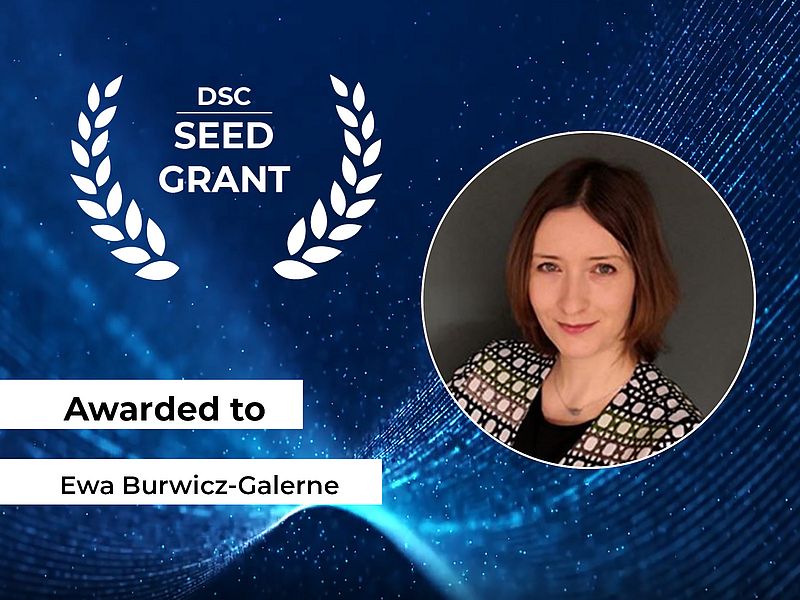
Funding recipient:
Dr. Ewa Burwicz-Galerne (MARUM – Center for Marine Environmental Sciences)
Funding period:
November 2025 – December 2025
Are you interested in the DSC Seed Grant?
You can find more information about the DSC Seed Grant here.
For questions, please contact:
Dr. Lena Steinmann
DSC Coordinator
Tel. +49 (421) 218 - 63941
E-Mail: lena.steinmannprotect me ?!uni-bremenprotect me ?!.de