
![[Translate to English:]](/fileadmin/user_upload/fachbereiche/fb3/didaktik/logo_ag_didaktik.png)
Projects
Current projects
CAMAP - Cultural Approach to Mathematical Argumentation: an international Project
Project period: Oct. 2020 - Mar. 2025 and Apr. 2025 - Mar. 2029, supported by the Japan Society for the Promotion of Science (JSPS KAKENHI)
Participants of the project: Christine Knipping, Nele Abels, Fiene Bredow (University of Bremen, Germany), Yusuke Shinno (Project leader, Hiroshima University, Japan), Ryoto Hakamata (Kochi University, Japan), Takeshi Miyakawa (Waseda University, Japan), Hiroki Otani (Otsuma Women's University, Japan), David A. Reid (University of Agder, Norway)
What is it about?
This international research project explores how mathematical argumentation, proof, and proving are shaped by cultural and linguistic contexts in classroom practice. The project is grounded on the assumption that cultural traditions, language use, and national curricula significantly influence how mathematical argumentation, proof, and proving are understood, taught, and enacted—and that these differences, in turn, affect students’ learning processes and outcomes.
This project conducts international comparative research on curricula, textbooks, and classroom practices, using classroom data to better understand how students and teachers engage in mathematical argumentation, proof, and proving. A key analytical lens is the triplet model of “structure”, “language”, and “function” (Miyakawa & Shinno, 2021) which enables a nuanced understanding of how culturally specific practices emerge in the teaching and learning of mathematical argumentation, proof, and proving.
The project pursues three main objectives: first, to develop an analytical framework for cross-national comparisons of mathematical argumentation, proof, and proving; second, to clarify how mathematical argumentation, proof, and proving are realized in classroom discourse across cultural contexts; and third, to explore the implications of these findings for teaching practices, curriculum design, and teacher education.
By highlighting the diversity of approaches to mathematical argumentation, proof, and proving, the project contributes to a deeper awareness of the cultural embeddedness of mathematics education. Cross-cultural comparison not only reveals differences but also makes visible the often implicit assumptions that shape teaching within one’s own context. In doing so, the project supports more reflective and inclusive educational practices and fosters dialogue across international research communities. Further information can be found on the website of the CAMAP.
find out more: CAMAP - Cultural Approach to Mathematical Argumentation: an international Project
#MOIN – Modellregion Industriemathematik: Ein Transferprojekt für eine nachhaltige und selbsttragende Modellregion Industriemathematik ("A transfer project for a sustainable and self-sustained model region industrial mathematics")
Since 2023, the #MOIN project has been funded by the Federal Ministry of Education and Research (BMBF) as one of 12 T!-Raum initiatives across Germany, with the aim of creating spaces for knowledge transfer to shape the future of regions.
Project period: December 2023 – December 2026
Participants of the project (in the project part "Campus - Nachbarschaft - Sichtbarkeit"): Prof. Dr. Christine Knipping (University of Bremen), Dr. Matthias Knauer (University of Bremen), Luisa Gunia (University of Bremen), Nora Niesert (University of Bremen), Bianka Hofmann (Fraunhofer MEVIS), Dr. Anna Rörich (Fraunhofer MEVIS), Rieke Alpers (Fraunhofer MEVIS)
Waht is it about?
The goal of the #MOIN project is to bring mathematics to life in schools, industry, politics, and society, and to demonstrate that (industrial) mathematics is accessible to everyone and full of opportunities. #MOIN pursues a holistic transfer approach and focuses on four key areas: #MATHWARE (industrial mathematics as a driver of innovation in industry), #MATHUP (industrial mathematics on the path to entrepreneurship), #MATHDAYS (industrial mathematics in schools), and #MATHINSIDE (industrial mathematics in the public sphere).
The #MATHDAYS outreach initiative focuses specifically on helping young people and their teachers understand the practical applications of mathematics. To this end, the program distinguishes between activities held on campus and those taking place in the young people’s local communities. These activities aim to make the region’s existing scientific, economic, and social innovation potential tangible and visible, in order to draw the attention of young people, their teachers, and other social actors to the potential of industrial mathematics and to increase their awareness of this potential.
The #MATHINSIDE module is aimed at the broader public and aims to highlight and share existing connections between the region and various aspects of mathematics and the history of mathematics. In doing so, new memorial sites will also be established to present (industrial) mathematics as a living discipline and actively influence the visibility of mathematics in the region.
Further information can be found on the #MOIN project website.
find out more: #MOIN – Modellregion Industriemathematik: Ein Transferprojekt für eine nachhaltige und selbsttragende Modellregion Industriemathematik ("A transfer project for a sustainable and self-sustained model region industrial mathematics")

Completed projects
Digi-Spotlights – Ein Lehrkonzept zur Verzahnung und Vernetzung von fachwissenschaftlichen und fachdidaktischen Inhalten im Lehramtsstudium ("A teaching approach for integrating and linking subject-specific and pedagogical content in teacher education")
The Digi-Spotlights project is an interdisciplinary and cross-disciplinary sub-project of the overall project "Schnittstellen gestalten" of the Qualitätsoffensive Lehrerbildung, funded by the Federal Ministry of Education and Research.
Project period: January 2016 - June 2019 (1st phase) and July 2019 - December 2023 (2nd phase)
Participants of the project: Prof. Dr. Angelika Bikner-Ahsbahs (leader of the project 1st phase, mathematics), Prof. Dr. Marcus Callies (English), Prof. Dr. Andreas Klee (Politics), Prof. Dr. Christine Knipping (leader of the project 2nd phase, Mathematics), Dr. Fiene Bredow, Dr. Erik Hanke, Stefanie Hehner, Nelli Mehlmann, Nils Quentel, Dr. Ingolf Schäfer, Daniela Schansker, Dr. Hendrik Schröder
What is it about?
While students, who want to become teachers, often very much welcome subject didactics in their studies because of their direct reference to teaching practice, the relevance of subject-specific courses for the teaching profession is less obvious to many. Also, connections between subject-specific science and other parts of the course, such as subject-specific didactics, are not always recognized.
In Digi-Spotlights, innovative teaching concepts (spotlights) are developed and refined that systematically interlink subject-specific and subject-specific didactic elements in university teacher training. This interlocking is examined with regard to the interconnection of the two content areas in the thinking and actions of students.
In the (further) developed teaching concepts of the three model concepts in the subjects English, mathematics and politics, subject-specific content is didactically prepared by the students and practically tested in a teaching experiment with students.
Further information can be found on the website of the Digi-Spotlights project.
Current doctoral projects
Marie-Theres Brehm
RisK-Design: Entwicklung von Risiko-Kompetenz im Stochastikunterricht. Eine Design-Based-Research Studie in der Sekundarstufe I
In her dissertation project, Marie-Theres Brehm deals with the development of risk competence in stochastics lessons. As part of the design-based research study, she developed a series of lessons on data- and concept-based statistical reasoning in the field of stochastics, which was tested with different school classes in Bremen in grades 9 and 10. Within the series of lessons, the work, evaluation and interpretation of data is focused on risk-related questions. Empirically based individual conceptions of risk and facets of risk competence are to be investigated.
The project is supervised by Prof. Dr. Angelika Bikner-Ahsbahs.
Luisa Gunia
Änderungen qualitativ denken – Argumentieren mit unterschiedlichen Sichtweisen auf den Funktions- und den Ableitungsbegriff
In her dissertation project, Luisa Gunia deals with imagination-oriented and conceptual argumentation in the field of qualitative analysis. For this purpose, she has developed a series of lessons on functional thinking in the area of analysis that is geared toward students' understanding and tested it with various school classes in Bremen in the introductory phase. Within the series of lessons, different perspectives on the concept of function and derivation and the interaction between existence and change are opened up. The aim is to examine what effects the change of perspective has on the arguments and argumentations produced by the students and which ideas about the concept of function and the concept of derivation are activated in each case.
The project is supervised by Prof. Dr. Christine Knipping.
Martin Ohrndorf
Explainer videos affect the learning of functions!?
In his dissertation project, Martin Ohrndorf is working qualitatively and quantitatively on the analysis of explainer videos and their effect on the learning of functions. First, Martin qualitatively examined explainer videos from YouTube and Sofatutor for three different types of learning opportunities: opportunities to establish validity (German: Geltung), opportunities to understand the function concept and opportunities to build relationships. Based on the opportunities to understand the function concept, a test on the conceptual knowledge of functions was developed in collaboration with Insa Meißner (University of Bremen). In a quasi-experimental pre-post design, the knowledge of 8th and 9th grade students was tested. In a first cohort, knowledge was examined in relation to the subjective perception of one's own knowledge of functions. In a second cohort, in collaboration with Vanessa Gross (University of Bremen), knowledge was examined in relation to the parasocial relationship using the videos and math anxiety.
In addition, Martin is working on a systematic literature analysis in collaboration with Sina Wetzel (University of Frankfurt am Main), Matthias Knippers (University of Bielefeld), Julia Marie Stechemesser (University of Duisburg-Essen), Juliane Wefers (University of Bielefeld) and Lia Brüggemeyer (University of Dortmund). With this literature analysis, they want to answer the question to what extent different definitions of mathematical explainer videos occur in the literature and on which underlying theories these definitions are based.
The project is supervised by Prof. Dr. Maike Vollstedt in collaboration with Prof. Dr. Florian Schmidt-Borcherding.
Reviewed conference and journal papers are marked with an asterisk (*).
* Ohrndorf, M., Meißner, I., Schmidt-Borcherding, F. & Vollstedt, M. (accepted). Reconstruction of opportunities to understand the function concept from online explainer videos. Thirteenth Congress of the European Society for Research in Mathematics Education (CERME13). Budapest, Hungary.
Ohrndorf, M., Vollstedt, M., & Schmidt-Borcherding, F. (2023). Rekonstruktion von Angeboten zur Herstellung von Geltung in Erklärvideos zu Funktionen – (Wie) geht das? Beiträge Zum Mathematikunterricht 2022, 1073-1076. Frankfurt a. M., Germany: 56. Jahrestagung der Gesellschaft für Didaktik der Mathematik. doi.org/10.17877/DE290R-23389
Ohrndorf, M. (2021). Verstehen verstehen. Eine Pilotstudie zur Überprüfung der Eye-Mind-Hypothese bei multimedialen Lernprozessen von Funktionen. WTM-Verlag Münster. doi.org/10.37626/GA9783959873000.0
| 16.03.2022 | Rekonstruktion von Angeboten zur Herstellung von Geltung in mathematischen Erklärvideos: (Wie) geht das? | 28. Kongress der Deutschen Gesellschaft für Erziehungswissenschaft (DGfE-Kongress 2022) digital |
| 31.08.2022 | Rekonstruktion von Angeboten zur Herstellung von Geltung in mathematischen Erklärvideos: (Wie) geht das? | 56. Jahrestagung der Gesellschaft für Didaktik der Mathematik (GDM-Tagung 2022) an der Goethe-Universität Frankfurt, Germany |
| 11.07.2023 | Reconstruction of opportunities to understand the function concept from online explainer videos | 13th Congress of the European Society for Research in Mathematics Education (CERME13) an der Eötvös Loránd University (ELTE) am Alfréd Rényi Institute of Mathematics in Budapest, Hungary |
| 18.09.2023 | Lernen mit Erklärvideos: Der Einfluss von Verstehensangeboten auf das Verstehen mathematischer Funktionen | 19. Fachgruppentagung Pädagogische Psychologie (PAEPS) an der Christian-Albrechts-Universität zu Kiel (CAU) am Leibniz-Institut für die Pädagogik der Naturwissenschaften und Mathematik (IPN) in Kiel, Germany |
Daniela Schansker
Von den natürlichen Zahlen zu den Dezimalbrüchen im dezimalen Stellenwertsystem: Ein Entwicklungsforschungsprojekt zur strukturfokussierenden Einführung der Dezimalbrüche mit der digitalen Stellenwerttafel
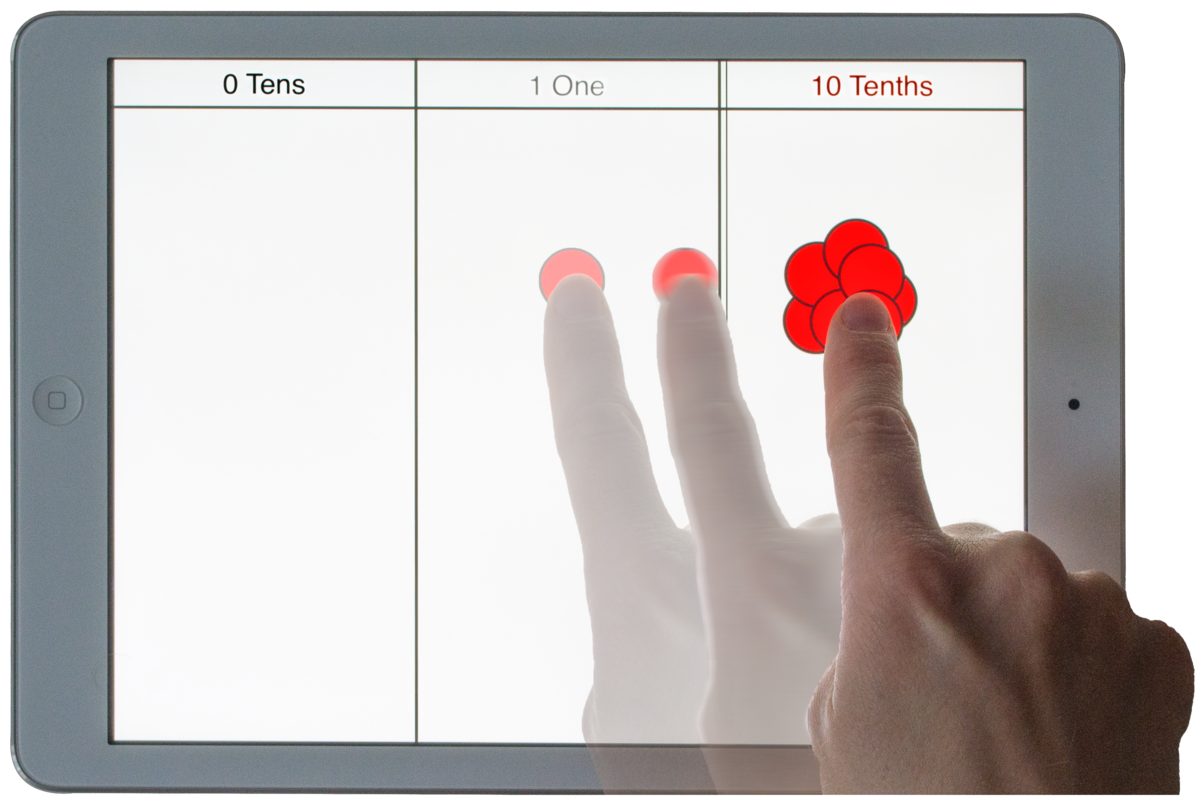
In her doctoral project, Daniela Schansker is investigating how a digital place value table on the iPad can be used to expand the decimal place value system from natural numbers to decimal fractions.
The project is supervised by Prof. Dr. Angelika Bikner-Ahsbahs.
Reviewed conference and journal papers are marked with an asterisk (*). Until 2017 I published under my birth name Behrens.
* Callies, M., Hanke, E., Klee, A., Knipping, C., Quentel, N., Schansker, D., & Schröder, H. (2023). Vier Seiten einer Medaille. Welche Rolle spielt das Fach bei der Verzahnung und Vernetzung von Fachdidaktik und Fachwissenschaft? heiEDUCATION Journal 9 (pp. 129–154).
Bikner-Ahsbahs, A., Burgarth, S., & Schansker, D. (2018). Komplementäres Scaffolding: digital und haptisch. In Fachgruppe Didaktik der Mathematik der Universität Paderborn (Ed.), Beiträge zum Mathematikunterricht 2018 (pp. 285–288). Münster: WTM-Verlag.
Behrens, D., & Bikner-Ahsbahs, A. (2017). Indexikalität von Zeichen als Erklärungsansatz für epistemische Prozesse mit der digitalen Stellenwerttafel. In U. Kortenkamp & A. Kuzle (Ed.), Beiträge zum Mathematikunterricht 2017 (pp. 67–70). Münster: WTM-Verlag.
* Behrens, D., & Bikner-Ahsbahs, A. (2017). The perspective of indexicality: How tool-based actions and gestures contribute to concept-building. In T. Dooley & G. Gueudet (Ed.). Proceedings of the 10th Congress of the European Society for Research in Mathematics Education (CERME10, 2017, pp. 2721–2728). Dublin, Irland: DCU Institute of Education and ERME.
Behrens, D., & Bikner-Ahsbahs, A. (2016). Die digitale Stellenwerttafel: Aufgabendesign zur Einführung der Dezimalbrüche. In Institut für Mathematik und Informatik der Pädagogischen Hochschule Heidelberg (Ed.), Beiträge zum Mathematikunterricht 2016 (pp. 117–120). Münster: WTM-Verlag.
* Behrens, D. & Bikner-Ahsbahs, A. (2016). The dragging gesture – from acting to conceptualizing. In C. Scíkos, A. Rausch & J. Szitányi (Ed.), Proceedings of the 40th Conference of the International Group for the Psychology of Mathematics Education (Vol. 2, pp. 67–74). Szeged, Ungarn: PME.
* Behrens, D. (2015). How a digital place value chart could foster substantial understanding of the decimal place value system. In K. Krainer & N. Vondrová (Ed.), Proceedings of the 9th Congress of the European Society for Research in Mathematics Education (pp. 2467-2472). Prag, Tschechische Republik: ERME.
Behrens, D., Krause, C.M., Bikner-Ahsbahs, A. (2014). „Ich zeig‘ uns was, was du nicht siehst“ – Zur epistemischen Rolle von Gesten. In J. Roth & J. Ames (Ed.), Beiträge zum Mathematikunterricht 2014 (pp. 149–152). Münster: WTM-Verlag.
Fabian Stöhr
Teaching stochastics inclusively with Borel Dice
In his dissertation project, Fabian Stöhr conducts a qualitative analysis of the game strategies that students develop during an inclusive lesson on the topic of probability and statistics. To this end, he has created a learning environment that serves as an inclusive lesson for teaching probability and statistics to a combined 7th and 8th grade class. The learning environment is built around the game Borel Dice and has been adapted for mathematics instruction. From a mathematics education perspective, he examines the reasoning and argumentation skills of students who develop and explain a game strategy during the course of the learning environment. The learning environment was created with inclusion-oriented pedagogical principles in mind and is intended to increase participation opportunities for students with learning disabilities.
The project is supervised by Prof. Dr. Christine Knipping.
Aylin Thomaneck
Students’ approaches when interpreting contextual graphs
In her PhD project, Aylin Thomaneck uses eye tracking to investigate how students interpret contextual graphs, i.e. graphs whose data originate from real-world contexts. First, she conducted a methodological case study to investigate how eye movements can be interpreted in contextual graph interpretation, to what extent they correspond to students’ cognitive processes while working on the tasks, and what contribution eye tracking can make in this subdomain. She is now using these findings for empirical studies on students' approaches in interpretation processes with different task requirements. In particular, she focuses on students’ approaches when capturing the change of contextual graphs and when matching a realistic image to a contextual graph–a task in which the graph-as-a-picture error frequently occurs.
The project is supervised by Prof. Dr. Maike Vollstedt.
Reviewed conference and journal papers are marked with an asterisk (*).
* Thomaneck, A., Vollstedt, M., & Schindler, M. (accepted). Matching a graph with an image representing the situational context: Students‘ approaches identified by using eye tracking. Thirteenth Congress of the European Society for Research in Mathematics Education (CERME13). Budapest, Hungary.
Thomaneck, A., Vollstedt, M., & Schindler, M. (2023). Eye-Tracking und Stimulated Recall Interviews zur Strategieanalyse bei der Erfassung der Änderung von Graphen.Beiträge zum Mathematikunterricht 2023, 1273-1276. Frankfurt a. M., Germany: Jahrestagung GDM. doi: 10.17877/DE290R-23277
* Thomaneck, A., Vollstedt, M., & Schindler, M. (2022). What can eye movements tell about students’ interpretations of contextual graphs? A methodological study on the use of the eye-mind hypothesis in the domain of functions.Frontiers in Education, 7. doi: 10.3389/feduc.2022.1003740
* Thomaneck, A., Vollstedt, M., & Schindler, M. (2021). Students‘ perception of change in graphs: an eye-tracking study.Proceedings of the Twelfth Congress of the European Society for Research in Mathematics Education (CERME12), 1-11. Bozen-Bolzano, Italy: CERME 12.
* Thomaneck, A., Vollstedt, M., & Schindler, M. (2021). Students‘ perception of change in graphs: an eye-tracking study.Proceedings of the 44th Conference of the International Group for the Psychology of Mathematics Education, Vol. 1, 184. Khon Kaen, Thailand: PME.
Thomaneck, A., Schindler, M., & Vollstedt, M. (2020). Kognitive Prozesse bei der Erfassung funktionaler Zusammenhänge: eine Eye-Tracking Studie.Beiträge zum Mathematikunterricht 2020, 1487. Würzburg, Germany: Jahrestagung GDM. doi: 10.17877/DE290R-21590
Completed doctoral projects
Dr. Estela A. Vallejo-Vargas (2023)
Title of the dissertation: Learning to Teach Through Proving: In-service Primary School Teachers’ Understanding and Use of Proving while engaged in Proof-Based Teaching
Supervised by Prof. Dr. David Reid.
Dr. Fiene Bredow (2023)
Title of the dissertation: Mathematisches Argumentieren im Übergang von der Arithmetik zur Algebra. Eine qualitative Studie von Lehrkrafthandlungen im Mathematikunterricht
Supervised by Prof. Dr. Christine Knipping.
Dr. Erik Hanke (2022)
Title of the dissertation: Aspects and images of complex path integrals. An epistemological analysis and a reconstruction of experts' interpretations of integration in complex analysis
Supervised by Prof. Dr. Marc Keßeböhmer.
Dr. Neruja Suriakumaran (2022)
Title of the dissertation: Understanding the conceptual interplay between learners’ motivation and patterns of personal meaning in the mathematics classroom: results from Germany and Finland
Supervised by Prof. Dr. Maike Vollstedt & Prof. Dr. Markku Hannula.
Dr. Nele Abels (2021)
Title of the dissertation: Argumentation und Metakognition bei geometrischen Beweisen und Beweisprozessen. Eine Untersuchung von Studierenden des Grundschullehramts
Supervised by Prof. Dr. Christine Knipping
Dr. Chrysi Papadaki (2021)
Title of the dissertation: The interconnective relationship of students’ visualization and argumentation in geometry
Supervised by Prof. Dr. Christine Knipping & Prof. Dr. David A. Reid.
Dr. Jenny Cramer (2017)
Title of the dissertation: Mathematisches Argumentieren als Diskurs. Eine theoretische und empirische Betrachtung diskursiver Hindernisse
Supervised by Prof. Dr. Christine Knipping.
Dr. Thomas Janßen (2016)
Title of the dissertation: Ausbildung algebraischen Struktursinns im Klassenunterricht : Lernbezogene Neudeutung eines mathematikdidaktischen Begriffs
Supervised by Prof. Dr. Angelika Bikner-Ahsbahs.
Dr. Christina Krause (2015)
Title of the dissertation: The Mathematics in Our Hands. How Gestures Contribute to Constructing Mathematical Knowledge
Supervised by Prof. Dr. Angelika Bikner-Ahsbahs.
Dr. Thomas Bardy (2015)
Title of the dissertation: Zur Herstellung von Geltung mathematischen Wissens im Mathematikunterricht
Supervised by Prof. Dr. Angelika Bikner-Ahsbahs