
![[Translate to English:] Zur Startseite des Instituts](/fileadmin/user_upload/fachbereiche/fb4/produktentwicklung/logo/BIK-logo_ohne_schrift_WEB_RGB_v4_reduced.png)
EnSort
Motivation
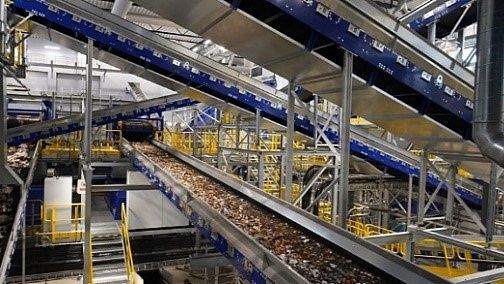
The growing importance of material recycling of waste in Germany and Europe requires a drastic improvement in the efficiency of waste treatment processes. With a recycling rate of 81% and a rising volume of local waste reaching 411.5 million tons in 2016, optimizing sorting processes is crucial. Current facilities are often only manually adjustable and react to changes in input composition with significant delays. This leads to inefficient energy consumption, overload situations, and quality issues. The EnSort project addresses this challenge by increasing the automation and intelligent control of sorting plants through AI technologies. The goal is to improve energy efficiency, optimize equipment utilization, and enhance the quality of recycled materials – a decisive step toward achieving the objectives of the Circular Economy Act and the new Packaging Act.
Approach
The project follows a systematic approach: first, extensive live data will be collected from existing facilities (SL Recycling Vechta, Veolia Hamburg), particularly from already installed NIR separators and additional sensors. These data form the basis for the development of a digital twin, designed as a hybrid model combining rigorous physical models with data-driven AI models. The University of Bremen develops artificial neural networks for data interpretation and generation of optimization recommendations. During a multi-month testing phase, the models are validated and continuously improved under real operating conditions. In this process, equipment parameters – such as rotational speeds, air flow rates, or paddle movements – are automatically adjusted to maximize utilization and achieve quality targets. The results are stored in a cloud environment and accessed via a RESTful API. Finally, large-scale industrial validation is carried out in practice, quantifying energy savings and quality improvements. The outcomes will be transferred to industry in the form of software components and best-practice guidelines.
Objective
The overarching goal of the EnSort project is to increase energy efficiency in waste and recyclable material sorting processes through a significant increase in the degree of automation. To achieve this, a data-driven model will be developed as a digital twin of the sorting plant, capable of simulating and optimizing the complex process. This model enables intelligent, fully automated control of the entire facility, dynamically adapting to changing input and output requirements. By optimizing equipment utilization, adjusting separation processes to material composition, and improving output quality, the specific energy consumption is expected to be reduced by up to 20%. In addition, the project promotes the production of homogeneous, optimally compacted bales, thereby simplifying logistics and material recovery.

Contact person
M.Eng. Marcel Wiechmann
+49 421 218-64864
mwiechmannprotect me ?!uni-bremenprotect me ?!.de
Dr.-Ing. Jan-Hendrik Ohlendorf
+49 421 218-64871
johlendorfprotect me ?!uni-bremenprotect me ?!.de