![[Translate to English:] Zur Startseite des Instituts](/fileadmin/user_upload/fachbereiche/fb4/produktentwicklung/logo/BIK-logo_ohne_schrift_WEB_RGB_v4_reduced.png)
IdEaL KI-SEE
Interdisciplinary Energy Research Laboratory - KI-Space for Energy Efficiency
Motivation
Rising global energy consumption, the target to reduce the use of fossil fuels and the associated objective of cutting climate-damaging greenhouse gas emissions have prompted the European Union, the German Federal Government and the Bremen State Government to take appropriate measures. The State of Bremen’s innovation strategy, ‘Key to Innovation 2030’, sets out how the State of Bremen, as a hub for innovation, intends to establish novel systems more firmly in business, research, education and society through sustainable economic management, resource efficiency and the advancement of digital networking and transformation. The future will be shaped in particular by innovative technologies for climate protection and new fields of work.
Energy research at the University of Bremen is already making a significant contribution to this today. The sustainable expansion of the research infrastructure for energy research is therefore essential in order to remain at the forefront of research and development in cutting-edge technologies, to respond to future challenges at an early stage, and to mitigate the associated risks through advanced technologies. By combining AI technologies and hardware-in-the-loop methods, the IdEaL laboratory aims to create a unique research environment to tackle the challenges posed by the energy transition.
Approach
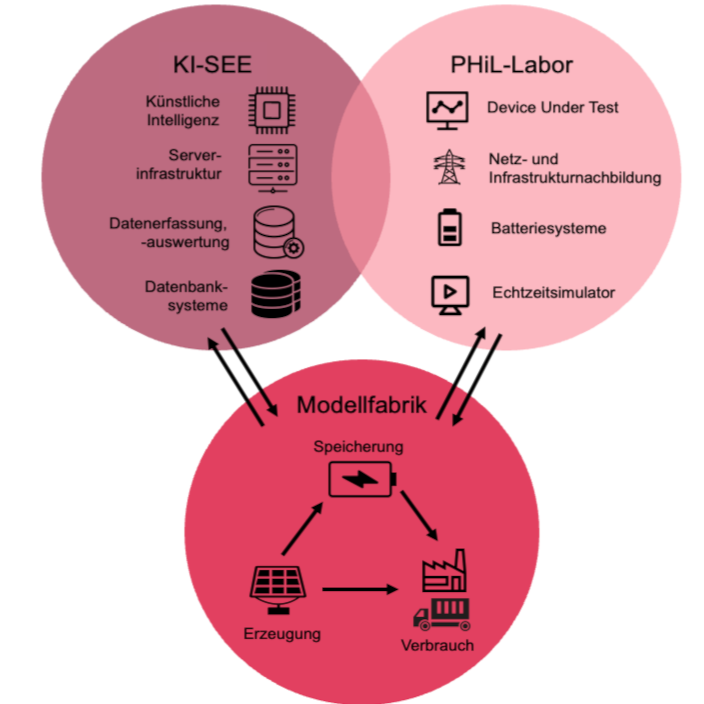
Through the Interdisciplinary Energy Research Laboratory, with its associated sub-projects within the KI-Space for Energy Efficiency (IdEaL KI-SEE), as well as the Power-Hardware -in-the-Loop Laboratory for Energy Networks (IdEaL PHiL Laboratory), in conjunction with the establishment of BIBA’s Model Factory (IdEaL MF), is playing a key role in promoting the expansion of the research infrastructure for energy research on the Bremen campus.
The KI-SEE creates a platform for the collection and analysis of energy data in order to develop innovative solutions for energy research. To this end, the IT infrastructure – such as database systems and an AI cluster – is being set up. Exemplary sensors and measuring equipment for data acquisition are also being installed.
Objective
The Interdisciplinary Energy Research Laboratory at the University of Bremen aims to improve the research infrastructure for researchers on the Bremen campus, with a view to creating a forward-looking and modern research infrastructure that enables the development and testing of innovative solutions for energy research. By combining AI technologies and hardware-in-the-loop methods, the laboratory will investigate the challenges posed by the energy transition. The laboratory is also intended to provide a platform for knowledge transfer between academia and industry, with a view to promoting the development of innovative products and services.