

Doktorandenstelle (m/w/d) aus dem Bereich Ingenieurwesen oder Biotechnologie
Salary level 13 TV-L (100%) within the project
Development of a microbial electrosynthesis cell for the treatment of aquaculture waste water
funded by The Research Council of Norway. The position is available from January 1st 2026 and fixed-term for 3 years, subject to approval through the third-party funding. The employment is governed by the Act of Academic Fixed-Term Contract, §2 (1) (Wissenschaftszeitvertragsgesetz – WissZeitVG). Therefore, candidates may only be considered for appointment if they still have the respective qualification periods available in accordance with § 2 (1) WissZeitVG.
Job description
Background:
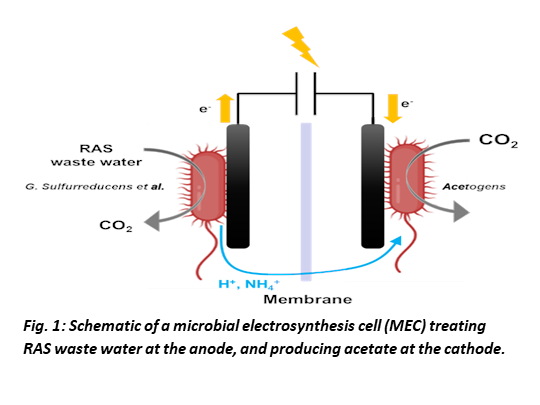
Conventionally, the waste water from land-based Recirculating Aquaculture Systems (RAS) undergoes an aerobic treatment step to remove organic carbon and nitrogen compounds. However, this process is not only energy-intensive, but so far does not offer the possibility to recover chemical energy or nutrients available from this waste stream. As an alternative, the Research Group Environmental Process Engineering at the University of Bremen (Germany) is developing Microbial Electrosynthesis Cells (MECs, Fig. 1). This novel technology promises energy-efficient waste water treatment combined with the recovery of nutrients and the production of valuable organic substances ranging from acetate over bioplastics to single cell protein.
The project:
Aim of this project is to develop a Microbial Electrosynthesis Cell (MEC) for the operation with waste water from Recirculating Aquaculture Systems. Within this international project with partners from the Norwegian University of Life Sciences (NMBU) our team is responsible for the systematic design, optimization and characterization of the MEC. This includes the identification of the optimal anode material/biofilm combination for operation with RAS wastewater and the selection of suitable separator materials that enable the recovery of nutrients. Furthermore, an optimized microbial cathode for acetate production, which is to be developed by the Resource Recovery Research Group of Assoc. Prof. Kocatürk Schumacher (https://www.nmbu.no/en/about/employees/nazli-pelin-kocaturk-schumacher) at NMBU, will have to be integrated into the system. The PROWAQ project is funded by The Research Council of Norway, and the position is integrated into the Research Group Environmental Process Engineering (Prof. Dr.-Ing. S. Kerzenmacher). Have a look at our website to learn more about the exciting topics we are working on:
https://www.uni-bremen.de/en/uvt
Your tasks:
- Performing bioelectrochemical experiments (e.g. chronoamperometry) to determine the optimal anode material/biofilm combination for operation with RAS wastewater
- Studying and modelling transport characteristics of separator materials with respect to protons, nitrogen species, phosphate and acetate
- Modelling-supported design, optimization and characterization of a bioelectrochemical cell
- Supporting the research group to study overarching questions and with day-to-day laboratory tasks
- Preparation/ writing of scientific manuscripts for publication in internationally renowned journals and presentations and scientific exchange at conferences
We offer:
- Independent work in an international and interdisciplinary team, in which cooperation and mutual support are of great importance
- Academic development in an international consortium and joint supervision by the Research Group Environmental Process Engineering in University of Bremen and Resource Recovery Group at NMBU.
- Various opportunities to contribute to shaping the research field
- A possibility to participate in the MAPEX doctoral qualification program. There you will be supported in acquiring the skills and competencies you need to successfully complete your doctorate and for later management tasks in academia or industry.
- Close supervision and mentoring to support you with your PhD project
Requirements
- Above-average academic university degree (M.Sc. or equivalent) in engineering, biotechnology, or a related field
- Practical lab experience, preferably in the field of biology or chemistry
- Experience with microbial electrochemical technologies, data analysis, programming (e.g. python) and simulation (e.g. COMSOL) would be of advantage
- Good English language skills in oral communication and writing of scientific reports (C1-level or comparable experience)
- Ambitious person who wants to drive this research project within an international interdisciplinary team
How to apply
Please send your application documents by November15th via email as one compiled pdf document to Prof. S. Kerzenmacher (kerzenmacherprotect me ?!uni-bremenprotect me ?!.de). It should contain your Academic CV (including list of publications if applicable), copies of BSc/ MSc degree transcripts and certificates (as well as work references if applicable), the contact information for 2 referees, and a Statement of Interest (1-page maximum) detailing specifically what motivated you to apply for the position, why you are interested in the proposed research topic and outlining your skills and experience that fit the post. For further information do not hesitate to contact Prof. Kerzenmacher directly.
General hints
The university is family-friendly, diverse and sees itself as an international university. We therefore welcome all applicants regardless of gender, nationality, ethnic and social origin, religion/belief, disability, age, sexual orientation and identity. As the University of Bremen intends to increase the proportion of female employees in academia, women are particularly encouraged to apply. Disabled applicants will be given priority if their professional and personal qualifications are essentially the same. Please note that any costs related to applications and interviews cannot be refunded.
We look forward to receiving your application!