Faculty 04: Production Engineering - Mechanical Engineering and Process Engineering
The University of Bremen is entering the race for excellence with two cluster applications

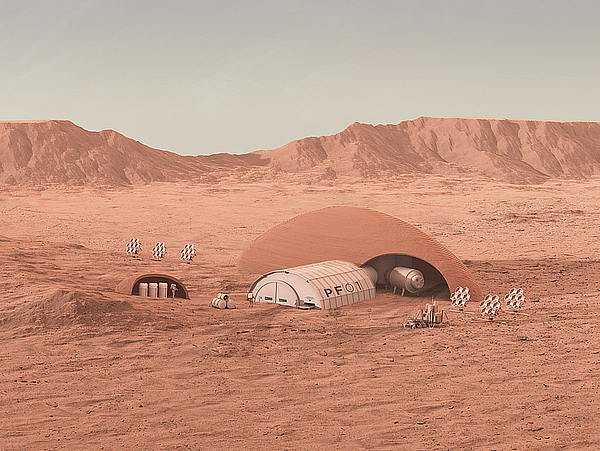
The full proposal from Bremen is entitled "The Mars Perspective: Resource Scarcity as the Basis of a Paradigm of Sustainability". "With the Mars Perspective, we will rethink the production of materials under the premise of resource scarcity," said Marc Avila, spokesperson for the cluster initiative and head of the Center for Applied Space Technology and Microgravity at the University of Bremen.

Prof. Dr. Kurosch Rezwan

Transfer project

University of Bremen as a pioneer: 30 million euros for the first center for accelerated technology transfer.

Bringing research to market readiness more quickly - that is the goal of the first "innovate! Center" in Germany. Sustainable solutions for technological challenges will be developed in three pilot projects from 2025. The Joachim Herz Foundation is supporting the venture with up to 30 million euros.

Veranstaltungen

15. Dec
Annette Schuhmann (Potsdam ) | Wir sind anders! Wie die DDR Frauen bis heute prägt.
Kassenhalle am Domshof
18:00 20:00
More
16. Dec
Mittagskonzert: Epische Klangwelten am Flügel: Klassik trifft Game & Film
Theatersaal der Universität
12:30 12:55
More
16. Dec
Dr.-Ing. Niklas Wolff (Kiel University): The New Nitrides – Thin Film Ferroelectrics with Wurtzite-type Structure
S1360, Geb. NW1, Otto-Hahn-Allee 1, 28359 Bremen
16:00 17:00
More
16. Dec
Lena Hezel (Tübingen): Ist Armut Diskriminierung? Perspektiven auf Klasse, Klassenverhältnisse und „Klassismus“
Studierhaus U Bremen
16:15 18:00
More
17. Dec
What can artists contribute to climate adaptation? (artec Lunch Talk)
SFG 2210
12:15 13:00
More
17. Dec
Profs gegen Rechts / Prof. Dr. Heike Radvan (Universität Tübingen): Betroffen von extrem rechter Dominanz in der Kommune – Erfahrungen, Handlungsoptionen, Gegenstrategien
Rotunde
18:15 19:45
More
17. Dec
Aus den Akten auf die Bühne - Karrieren in Bremen nach 1945 - Kurt A. Becher – Käthe Popall – Alfred Ries
Theater am Leibnizplatz
19:30 22:00
More
18. Dec
Nobelpreiskolloquium, Prof. Dr. Philip Moll (Max Planck lnstitut für Struktur und Dynamik der Materie, Hamburg): "Quantum mechanics goes big"
Hörsaal H3, Geb. NW1, Otto-Hahn-Allee 1, 28359 Bremen
16:00 17:00
More
18. Dec
Towards exploration of stacks of highly heterogeneous technologies with very fine-pitch 3D connectivity
NW1, U1050
16:00 17:30
More
19. Dec
An Evening with Maksym Butkevych
Europapunkt
18:00 21:00
More
06. Jan
Mittagskonzert: „Befreiung naht!“ – Eigene Kompositionen und Texte zum CD-Release
Theatersaal der Universität
12:30 12:55
More
08. Jan
Gereon Niedner-Schatteburg (Univrsität Kaiserslautern)
Hörsaal H3, Geb. NW1, Otto-Hahn-Allee 1, 28359 Bremen
16:00 17:00
More
11. Jan
LiteraTour Nord: Reading tour 2025/26 – Katerina Poladjan
Theater Bremen, Goetheplatz 1-3
20:00 21:30
More
13. Jan
Mittagskonzert: Vier Hände, viele Klangwelten
Theatersaal der Universität
12:30 12:55
More
13. Jan
Benjamin Goossen (Boston) | Mennonites and Lebensraum. Situating a Christian Denomination in Hitler‘s Empire
Online
18:00 20:00
More
14. Jan
Vortrag | Ringvorlesung Gefährdete Demokratie | WOC & Profs gegen Rechts Rahel Jaeggi (Berlin): Regressive Demokratie – Regressive Moderne
Rotunde
18:15 20:00
More
14. Jan
Profs gegen Rechts / Prof. Dr. Rahel Jaeggi (Humboldt Universität zu Berlin): Regressive Demokratie – Regressive Moderne
Rotunde/Cartesium
18:15 19:45
More
15. Jan
Migrantische Arbeitskämpfe und Machtressourcen in der Fleischindustrie
Forum am Domshof
16:00 18:00
More
19. Jan
Heidi Hein-Kircher (Herne/Bochum) | Die Sittenreformbewegung in Polen als Teil einer europäischen Lebensreformbewegung in der ersten Hälfte des 20. Jahrhunderts
IW3 0330
18:00 20:00
More
20. Jan
Mittagskonzert: Alle Wege führen zum Tango
Theatersaal der Universität
12:30 12:55
More
21. Jan
Vortrag und Buchdiskussion | WOC Agora #12 Florian Sprenger (Bochum): Ich-Sagen. Genealogie der Situiertheit
Cartesium Rotunde U Bremen
18:15 19:45
More
23. Jan
YUFE R&R Webinar Series: Work Well-Being in Academia
Online
10:00 12:00
More
25. Jan
LiteraTour Nord: Reading tour 2025/26 – Annett Gröschner
Theater Bremen, Goetheplatz 1-3
20:00 21:30
More
26. Jan
Seth Bernstein (Gainesville) | Big Brother Where Art Thou? Police Intelligence and Artificial Intelligence in Soviet Secret Police Archives
Online
18:00 20:00
More
27. Jan
Mittagskonzert: Dos a Cu4tro: "Solo Solare" – Ein Portraitkonzert
Theatersaal der Universität
12:30 12:55
More
27. Jan
Tag des Gedenkens an die Opfer des Nationalsozialismus
GW 1 Hörsaal
16:00 18:00
More
28. Jan
Das Goldene Plietsch 2026
Forum am Domshof
16:30 Open End
More
01. Feb
„In das Unbekannte“ – Semesterabschlusskonzert von Orchester und Chor der Universität Bremen
Theatersaal der Universität
17:00 19:00
More
18.20. Feb
Research – Attitude – Activism? Inclusion Research between Educational Utopia and System Conformity
University of Bremen
All day
More
24. Feb
Bremer Ocean Day
Campus Uni Bremen, Hörsaalgebäude (Keksdose)
09:30 12:30
More
09. Apr
Prof. Dr. Matthias Bartelmann (Universität Heidelberg): Universalität kosmischer Strukturen
Hörsaal H3, Geb. NW1, Otto-Hahn-Allee 1, 28359 Bremen
16:00 17:00
More
13. Jun
OPEN CAMPUS
Campus der Universität Bremen
All day
More
13. Jun
Open Campus der Universität Bremen
All day
More
15. Jun
Gesellschaftliche Unterschiede: Warum wir uns voneinander untrscheiden und warum das (manchmal) wichtig ist
Hanse-Wissenschaftskolleg, Lehmkuhlenbusch 4, 27753 Delmenhorst
19:30 21:00
More
22.26. Jun
Sommerakademie
Universität Bremen
All day
More
24. Jun
Info-Tag für Studieninteressierte 2026
Campus der Uni Bremen
08:30 16:00
More
17. Aug
Bernsteine: Zeitkapseln der Evolution
Hanse-Wissenschaftskolleg, Lehmkuhlenbusch 4, 27753 Delmenhorst
19:30 21:00
More
03. Sep
Warum wir wählen, was wir wählen: Unser Wahlverhalten in unsicheren Zeiten
VHS Delmenhorst, Am Turbinenhaus11, 27749 Delmenhorst
19:30 21:00
More
05. Oct
Wahlmanipulation im digitalen Zeitalter: Wo liegen die Gefahren?
Hanse-Wissenschaftskolleg, Lehmkuhlenbusch 4, 27753 Delmenhorst
19:30 21:00
More
02. Nov
Wölfe in Niedersachsen
Hanse-Wissenschaftskolleg, Lehmkuhlenbusch 4, 27753 Delmenhorst
19:30 21:00
More
All Events

Mission statement FB4

The guiding principles are listed below. Below are the statements that were developed in a departmental meeting.


We are internationally visible and attractive in research and teaching.

The FB4 is internationally perceived as a beacon in research and teaching.

The attractiveness is expressed, among other things, in the fact that both the research topics and approaches as well as the degree programs are internationally sought after.

Research and teaching continue to be characterized by the top performances of individuals. However, these achievements are not singularities, but rather building blocks of a homogeneous overall picture.

We recognize trends early on and integrate them into teaching and research.

We train people to solve social challenges with new technologies.

Through training at the FB4, people are prepared for numerous and diverse career paths. They learn the basics of engineering using specific technologies in manageable groups. In addition to the technical aspects, we promote the skills and competencies of the people in the FB4 and thus develop personalities for business and science. Ultimately, we are the springboard to the future.

We develop further in line with the changing requirements of the FB; this applies to both HL and the middle management.

We are achieving full teaching capacity.

We are increasing the proportion of external students to 30%. [External = high school diploma outside a 100 km radius].

Because of our attractiveness, we have more applicants than places

We have clearly identifiable priorities: the design of process chains and technical systems in which we contribute to solving social challenges.


We research technologies to improve people's lives. This is one way to put people at the center. To this end, we act as engineers who actively shape the future of our society through research and teaching. In doing so, we work coherently on sustainable, technical solutions.


We have a strategy and staff for external communication.

We communicate science to the outside world and internally using modern media in a target group-oriented manner.

We convey joy and arouse enthusiasm for technology.

We have a clear line that we stand by reliably, without losing our ability to change and adapt. People are always the focus here.

The teachers' individual enthusiasm for technical solutions that serve people is contagious and carries the learners along with them.

We actively support our students in their personal and professional development.

We allow for individuality and value it without losing sight of the bigger picture.

The diversity of the focus areas offers numerous interfaces where the subject boundaries can be left (transdisciplinarity) without giving up the identity of the individual groups.

The wide thematic breadth of the subject areas, combined with the close internal networking, allows for rapid exchange on a variety of topics and thus also close-meshed trend scouting.

Fields of action are derived from the focus areas of the department, which are regularly evaluated.

Based on strong basic research, we develop innovative technologies with industry.

The stakeholders see us as reliable partners and experts in solving social problems.

We look at every question from different perspectives (inter-/transdisciplinary).

All university lecturers are involved in undergraduate teaching.

We enable the development and implementation of new ideas and act as an incubator for spin-offs managed by employees.

Students feel that they are treated fairly and respectfully.

We live a common FB culture whose decisions are based on the principle of strong consensus. [Strong = 80% of people agree at least 80% of the time].

The FB and the non-university institutes managed by its members act in a unified manner in research and teaching.

Updated by: bolik