

The Martian Mindset
Cluster of Excellence The Martian Mindset
A Scarcity-Driven Engineering Paradigm
Scarcity of resources is rapidly becoming a key challenge for humankind. Accordingly, many research efforts worldwide are focused on achieving a more sustainable, efficient and automated production. In our Cluster, we take a radically new perspective, aiming at a long-term paradigm shift. We place ourselves on Mars, a potentially habitable but inhospitable world, without fossil fuels or extensive water resources and surrounded by a thin CO2 atmosphere. We embrace these extreme boundary conditions to develop the Martian Mindset as a new, scarcity-driven paradigm for the production of enough-to-use materials and parts.
The Cluster is funded by the German Science Foundation (Deutsche Forschungsgemeinschaft, DFG) from 2026 to 2032 through the Excellence Strategy of the German federal and state governments. It builds upon the decades-long scientific excellence of the University of Bremen and its partner institutes in the fields of materials, processes, production, robotics and space engineering.
Research
The Martian Mindset is guided by scarcity constraints in four dimensions—natural resources, electric power, human workforce, and information. The research focuses on the sourcing of materials, the processing to parts and the design of operating concepts. We pursue three main goals: (1) develop (bio-)electrochemical methods for the synthesis of raw materials from low-grade resources; (2) design and demonstrate low-energy process chains that use these raw materials as input to produce a variety of enough-to-use parts; and (3) devise concepts for production facilities jointly operated by human-robot teams and supported by digital representations of the processes and production.

Sourcing
The development of (bio)electrochemical methods that do not require fossil fuels and can be used to extract metals, plastics, and other (vital) raw materials such as oxygen even from low-grade starting materials.
find out more: Sourcing
Processing
The experimental demonstration of low-energy process chains with which a range of components of “enough-to-use” quality can be produced from the raw materials obtained.
find out more: Processing
Operating
The design of novel operating concepts for production systems that are operated jointly by small teams of humans and robots under great uncertainty and with limited information.
find out more: OperatingLogbook

Research Stay at Politecnico di Milano

Mars Research from Bremen Presented at the German Bundestag

Christiane Heinicke Discusses the Future of Human Spaceflight on SWR1
© The Martian Mindset
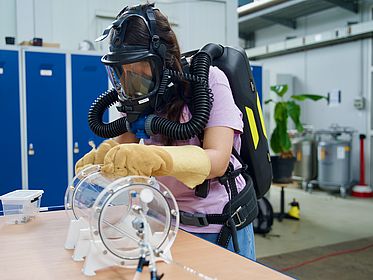
The first Micro Mission brings together the research perspectives of the Martian Mindset Cluster of Excellence
© Wiebke Hahn
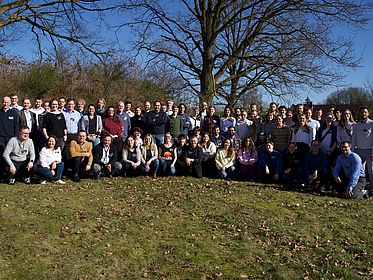
The launch towards Mars research: a report of the very first Cluster-Retreat
© Universität Bremen, Joris Wegner
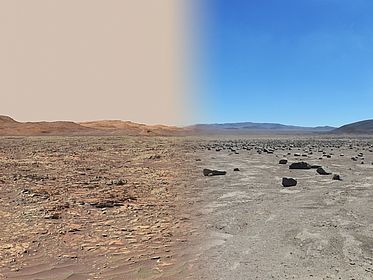
Research team sets off for the Atacama Desert – to better understand Mars
© University of Bremen
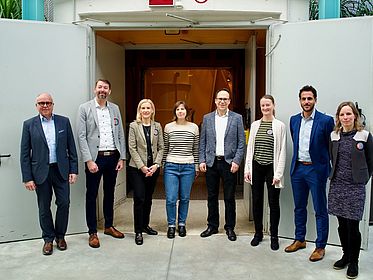
Visit of State Councilor for Environment, Climate, and Science, Karolina Kumar

© Matej Meza, University of Bremen
Historic Success: University of Bremen Acquires Funding for Two Clusters of Excellence for the First Time

© Universität Bremen
University of Bremen Enters the Race for Excellence with Two Clusters
Humans on Mars Initiative

The Cluster of Excellence “The Martian Mindset” builds on decades of scientific expertise in two of Bremen's research and transfer priority areas: Materials Science and Technologies and Aerospace Engineering. Since 2021, the “Humans on Mars” initiative has merged and enhanced this with the fields of behavioral sciences and communication technology to form an interdisciplinary consortium.
find out more: