

Mitochondrien
Mehrzellige Organismen werden von zahlreichen, oft hochdynamischen Zellorganellen, den so genannten Mitochondrien, mit Energie versorgt.
Ein einzelnes Mitochondrium setzt pro Sekunde "zwischen 10.000 und 50.000 Mal mehr Energie um als die Sonne". (1)
Abgesehen von ihrer beeindruckenden Rolle bei der Energieerzeugung sind Mitochondrien an verschiedenen zellulären Prozessen beteiligt, darunter an der Ca2+-Signalübertragung, der Redox-Homöostase und der Regulierung des programmierten Zelltods (2).
Mitochondriale Codes und Kommunikation
Mitochondrienassoziierte Krankheiten
Beim Menschen gehören mitochondrienassoziierte Krankheiten zu den häufigsten vererbten genetischen Störungen (3). Beispiele hierfür sind Diabetes, Krebs, neurodegenerative und kardiovaskuläre Erkrankungen (4-7). Kürzlich wurde festgestellt, dass Mitochondrien an der Regulierung des Schlafs beteiligt sind (8), was die große Bedeutung dieser winzigen Organellen weiter unterstreicht.
Die bisherige Forschung hat sich hauptsächlich auf Mitochondrien in ihrer Gesamtheit konzentriert. Mehrere Studien haben jedoch über eine bemerkenswerte mitochondriale Heterogenität sowohl zwischen als auch innerhalb von Zellen berichtet. Die biologische Bedeutung dieser Unterschiede ist nicht gut verstanden, was zu einem großen Teil auf technische Beschränkungen zurückzuführen ist, die mit der Analyse von Mitochondrien auf der Ebene einzelner Zellen oder sogar einzelner Mitochondrien verbunden sind.

Regulierung der zellulären Lebensspanne
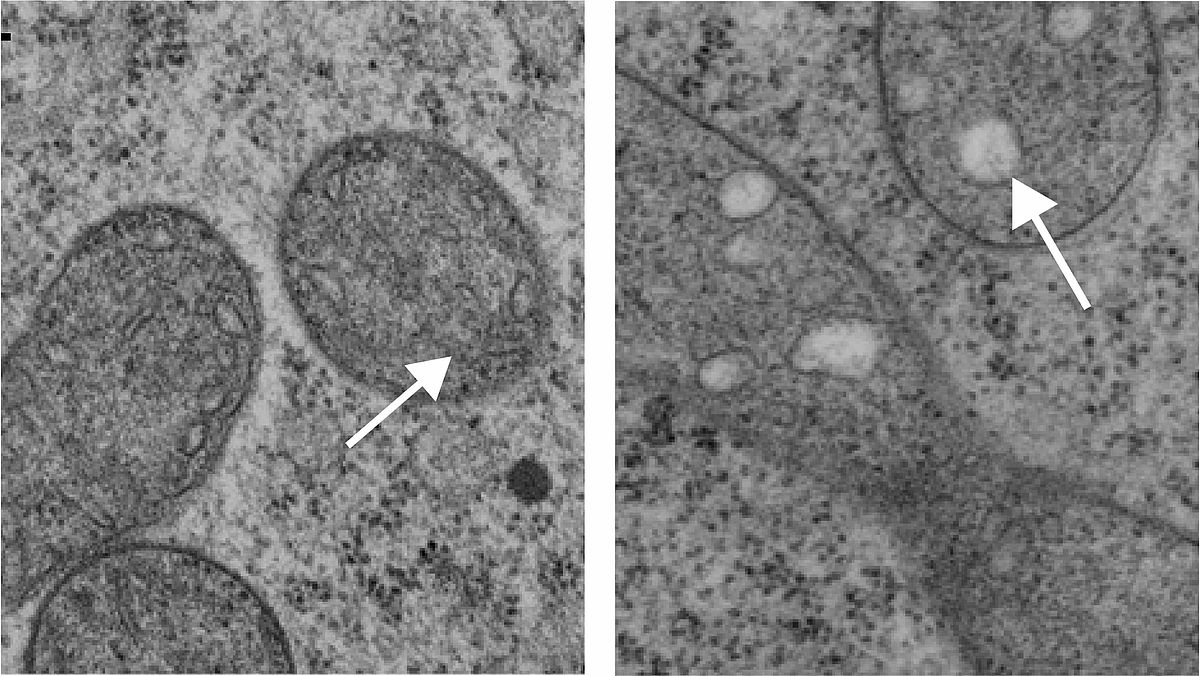
Wir fanden heraus, dass die Cysteinyl-tRNA-Synthetase SYCO in der zentralen Zelle, dem Vorläufer des Nährgewebes des Embryos, exprimiert wird, aber nicht in den angrenzenden antipodalen Zellen, die in Syco-Mutanten eine verlängerte Lebensspanne aufweisen. SYCO ist in den Mitochondrien lokalisiert, und die ultrastrukturelle Analyse der mutierten zentralen Zellen ergab, dass das Protein für die Integrität der mitochondrialen Cristae notwendig ist. Darüber hinaus verursachte ein dominanter ATP/ADP-Translokator eine mitochondriale Cristae-Degeneration und verlängerte die antipodische Lebensspanne, wenn er in der zentralen Zelle von Wildtyp-Pflanzen exprimiert wurde. Bemerkenswerterweise wirkte sich dieses Konstrukt nicht auf die Lebensdauer der Antipodien aus, wenn es in den Antipodien exprimiert wurde.
Unsere Ergebnisse weisen somit auf eine unerwartete, nicht zellautonome Rolle der Mitochondrien bei der Regulierung der zellulären Lebensspanne hin und lenken die Aufmerksamkeit von der sterbenden Zelle auf benachbarte, nicht sterbende Zellen als mögliche Ursache für den programmierten Zelltod (PCD) (Kägi et al. 2010).
Literatur
- Schatz, G. The Magic Garden. Annual Review of Biochemistry 76, 673-678 (2007).
- A. V. Kuznetsov, R. Margreiter, Heterogeneity of mitochondria and mitochondrial function within cells as another level of mitochondrial complexity. Int J Mol Sci 10, 1911-1929 (2009).
- R. N. Lightowlers, R. W. Taylor, D. M. Turnbull, Mutations causing mitochondrial disease: What is new and what challenges remain? Science 349, 1494-1499 (2015).
- S. B. Ong et al., Inhibiting mitochondrial fission protects the heart against ischemia/reperfusion injury. Circulation 121, 2012-2022 (2010).
- P. H. Reddy et al., Dynamin-related protein 1 and mitochondrial fragmentation in neurodegenerative diseases. Brain Res Rev 67, 103-118 (2011).
- M. Williams, M. C. Caino, Mitochondrial Dynamics in Type 2 Diabetes and Cancer. Front Endocrinol (Lausanne) 9, 211 (2018).
- Y. Yoon, C. A. Galloway, B. S. Jhun, T. Yu, Mitochondrial dynamics in diabetes. Antioxid Redox Signal 14, 439-457 (2011).
- L. Melhuish Beaupre, Gregory M. Brown (2022) Mitochondria’s role in sleep: Novel insights from sleep deprivation and restriction studies, The World Journal of Biological Psychiatry, 23:1, 1-13, DOI: 10.1080/15622975.2021.1907723