Research Topics in the Field of Particle Separation
Dielektrophoresis
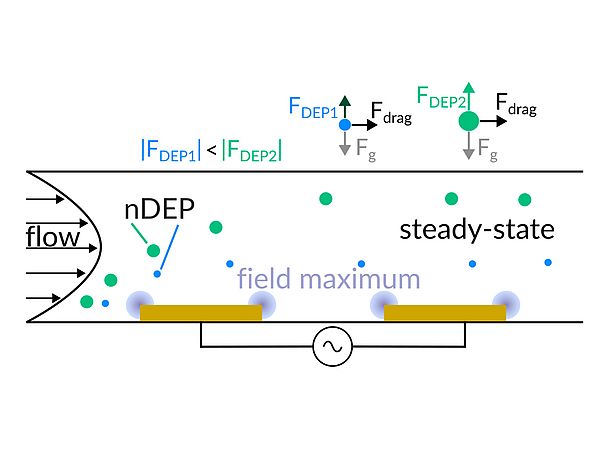
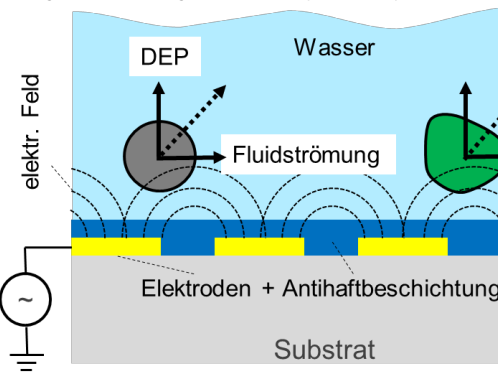
Dielectrophoresis (DEP) describes the movement of charged and uncharged particles in inhomogeneous alternating electric fields. Dielectrophoresis occurs when an induced dipole is exposed to a spatially uneven field. DEP thus enables the development of methods for separating particle mixtures where conventional separation methods fail. This is the case, for example, in the separation of very small particles or in the separation of particles that exhibit only subtle differences in properties, e.g., the separation of blood cells according to blood type.
We use DEP to separate technical particle mixtures according to material, and our focus is specifically on material separation at high (industrially relevant) throughput. This contrasts with many conventional DEP applications, where the method is used for (bio)analytical purposes with high accuracy but low volumes to be examined. A good overview of DEP applications can be found, for example, in Hughes' review paper.
In particular, our research can be divided into the following sub-areas: