Nicolas Braud, Lars Buß, Lindsay Richard Merte, Harald Wallander, Jon-Olaf Krisponeit, Thomas Schmidt, Edvin Lundgren, Jan Ingo Flege, Jens Falta
Ultramicroscopy 278 (2025): 114243
https://doi.org/10.1016/j.ultramic.2025.114243
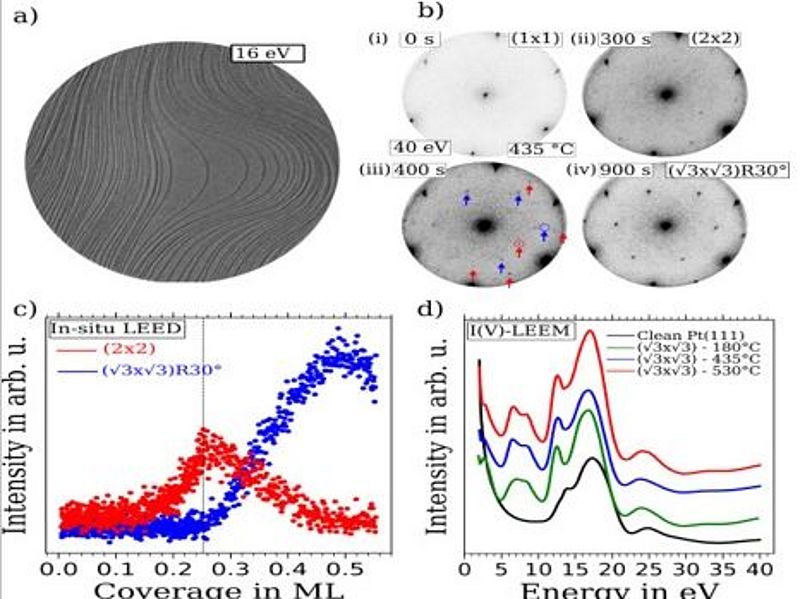
The preparation of ultra-thin PtSn-alloyed layers by molecular beam epitaxy was studied using low-energy electron microscopy (LEEM) and micro-diffraction (μ-LEED). Deposition at a sample temperature of 435 °C initially results in the formation of a Pt₃Sn/Pt(111) layer showing a (2 × 2) reconstruction. With continued Sn deposition, a Pt₂Sn/Pt(111) layer develops, showing a (√3 × √3)R30° reconstruction. An ultra-thin tin oxide was formed from the (2 × 2) surface by exposure to molecular oxygen at temperatures of 500 °C and 590 °C, respectively. LEED shows the evolution of a new surface structure, which could be identified as an incommensurate rectangular (2.3 0 1.8 3.6) reconstruction with lattice parameters of a = (6.4 ± 0.1) Å and b = (8.6 ± 0.1) Å present in three domains rotated by 120° with respect to each other. This structure can be related to the zigzag reconstructions found for similar ultra-thin oxide systems. Contrarily, the (√3 × √3)R30° structure showed no oxide formation even after extensive exposure to molecular oxygen. The usage of atomic oxygen, however, allows for oxidation of this surface and the growth of thicker oxides on both types of overlayers. At 500 °C this process is accompanied by substantial roughening of the surface.