

Electrokinetic antifouling
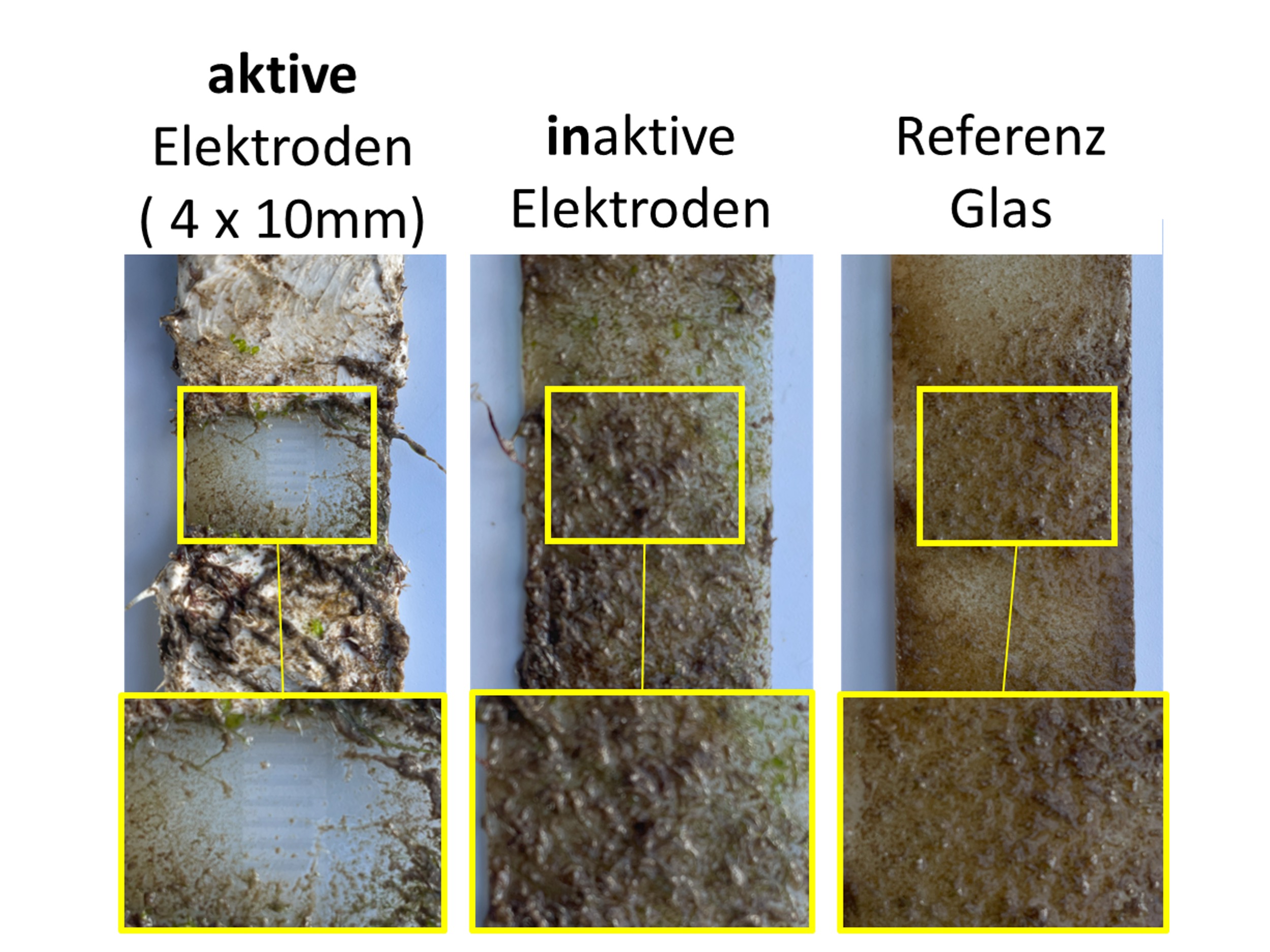
Electrokinetic antifouling describes a series of processes that use alternating electric fields to keep particles, microorganisms, or sediments away from surfaces. This technology is particularly relevant for applications such as membrane bioreactors (MBR) or underwater optical systems, where fouling leads to significant performance losses.
Dielectrophoresis (DEP) – the directed movement of polarizable particles in a non-homogeneous electric field – plays a central role here. Due to their lower permittivity compared to water, many biological particles experience a negative DEP force, causing them to be repelled from electrodes or membrane surfaces. This effectively suppresses the formation of surface layers and pore blockages on membranes.
In membrane bioreactors, a layer of dirt consisting of filtered particles or organisms forms on the surface of the filter modules after a period of operation. Conventionally, such layers are removed from the membrane by backwashing (i.e., reversing the flow direction). By inserting electrodes below or above the filtration surface, inhomogeneous electric fields can be generated that polarize the (bio)particles and thus prevent them from depositing. This effectively extends the time required for backwashing by applying a (low) voltage.
In addition to applications in wastewater technology, electrokinetic antifouling is also gaining importance in the field of underwater optical systems. Here, the negative DEP effect is combined with electrothermal currents generated by Joule heating. Asymmetric electrodes generate directed microcurrents that not only repel particles but also actively remove them from the surface. This strategy is transparent, non-toxic, and ideal for use on cameras or sensors in seawater environments.
Relevant prublications in this field
Jiang, H., Wang, Y., Du, F., Stolte, S., Specht, U., Pesch, G. R., & Baune, M. (2024). A universal AC electrokinetics-based strategy toward surface antifouling of underwater optics. Scientific Reports, 14(1), 16125.
https://doi.org/10.1038/s41598-024-66251-2
Hawari, A. H., Larbi, B., Alkhatib, A., Du, F., Baune, M., & Thoeming, J. (2019). Insulator-based dielectrophoresis for fouling suppression in submerged membranes bioreactors: Impact of insulators shape and dimensions. Separation and Purification Technology, 213, 507-514.
https://doi.org/10.1016/j.seppur.2018.12.084
Du, F., Hawari, A. H., Larbi, B., Ltaief, A., Pesch, G. R., Baune, M., & Thöming, J. (2018). Fouling suppression in submerged membrane bioreactors by obstacle dielectrophoresis. Journal of Membrane science, 549, 466-473.
Contact
Dr. rer. nat. Fei Du
feiduprotect me ?!uni-bremenprotect me ?!.de