
Cognition-Based Artificial Intelligence
Humans and AI Learning Together
The artificial intelligence (AI) of the future must not only be able to generate plausible solutions, it must also be able to test and assess these solutions. AI systems should have the cognitive ability to understand how and why they do something and where their knowledge gaps lie. For this purpose, we are researching a new framework for joint learning between humans and AI systems in Bremen: The concept of co-construction.
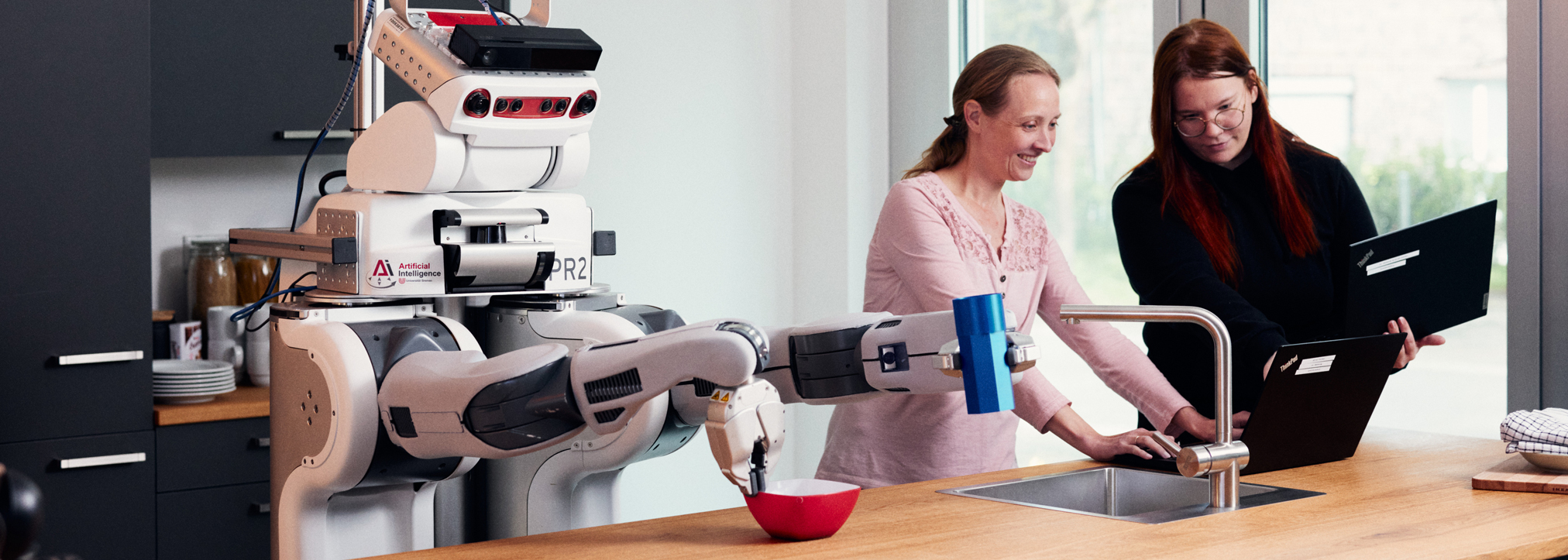
Co-construction describes mechanisms by which humans and machines understand tasks together and find solutions in stages. This enables AI systems to develop intelligence together with humans and act accordingly. In Bremen, we not only develop these AI models, but also embed them in state-of-the-art robots so that AI can support people in a very practical way.
find out more: Humans and AI Learning TogetherContact
Do you have a question? Get in touch!
Leonie Dziomba
dziombaprotect me ?!uni-bremenprotect me ?!.de
+49 421 218-64018
CoAI Joint Research Center
Developing Cognitive and Cooperative AI Together
In order to develop the foundations for future AI models that utilize these capabilities, top researchers from the fields of AI, cognitive robotics, cognitive systems, human-computer interaction, medical assistance, linguistics, psychology. and philosophy are needed. The Joint Research Center on Cooperative and Cognition-enabled AI (CoAI JRC) brings together this expertise as a joint research center of the Universities of Bremen, Bielefeld, and Paderborn. We pursue a common mission that unites our research at all three locations: developing the foundations for new cooperative AI systems that learn with and from people and support us in the real world.
find out more: CoAI Joint Research CenterNews

© Institute for Artificial Intelligence / Uni Bremen
Looking back at this year’s EASE Fall School

© Patrick Pollmeier / Universität Bremen
Robots with Common Sense

© Lukas Klose / Universität Bremen
Virtual Robotics Lab for Students
![[Translate to English:] Ein Roboter hält eine Schüssel fest, die auf einem Tisch steht. Im anderen Arm hält er einen Becher, aus dem er offensichtlich etwas ausschütten will.](/fileadmin/_processed_/1/3/csm_20230504_UniBremen_Pollmeier_0704_6b344cd7a6.jpg)
New Co-constructive Artificial Intelligence Center

© Patrick Pollmeier / Universität Bremen