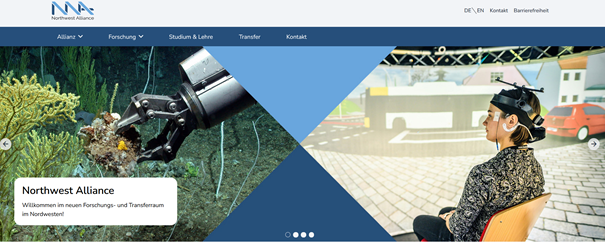

© Northwest Alliance / Jens Lehmkühler


Unfortunately, the Northwest Alliance (NWA), the consortium formed by the Universities of Bremen and Oldenburg, was not selected as a University Excellence Consortium in the current round of the Excellence Strategy of the German federal and state governments. The German Science and Humanities Council announced which locations will receive funding on Oct 2, 2026. The Universities of Bremen and Oldenburg will continue and further develop their cooperation to strengthen the Northwest as a research region, together with their most important partner, the University of Groningen.
The bid to become a University Excellence Consortium followed one of the greatest successes in the history of the two universities. In spring 2025, they secured approval for a total of four Clusters of Excellence in the corresponding funding line of the Excellence Strategy. This meant they had more than met the requirements for applying as a University Excellence Consortium.
With the successful renewal proposal "The Ocean Floor - Earth's Uncharted Interface" and the successful new proposal "The Martian Mindset - A Scarcity-Driven Engineering Paradigm," two Clusters of Excellence will be funded at our university for the first time since January 1, 2026!
We look forward to your questions and suggestions about the University of Bremen’s Excellence Strategy!
Dr. Maike Koschorreck
Excellence and strategic university development
E-Mail: exzellenzprotect me ?!uni-bremenprotect me ?!.de
Phone: +49-(0)421-218-60018
VWG, Room 2270


Since its establishment in 2019, “The Ocean Floor - Earth’s Uncharted Interface” Cluster of Excellence has been based at MARUM - Center for Marine Environmental Sciences at the University of Bremen. As of January 2026, the cluster team will continue its work together with the ICBM – Institute for Chemistry and Biology of the Marine Environment at the University of Oldenburg. In the cluster's upcoming second funding phase, the strong disciplinary expertise in deep-sea research that has developed over decades across northwestern Germany will be consolidated in an even closer manner. The aim is to create a marine region of excellence that will enable new scientific breakthroughs. The cluster investigates exchange processes on the ocean floor as an important and dynamic interface of the Earth system that plays a vital role in the functioning of our planet and its climate. The research findings will be of great importance for better understanding climate scenarios in a warming world.
find out more: “The Ocean Floor” Cluster of Excellence
The second cluster to receive Excellence funding at the University of Bremen comes from MAPEX - Center for Materials and Processes. The cluster builds on the preliminary work of the Humans on Mars initiative that was established in 2021. The interdisciplinary cluster team includes researchers from the natural and engineering sciences, mathematics, behavioral sciences, and communications technology. Together, the scientists are adopting "The Martian Mindset" to rethink the production of materials and components from the ground up. The scarce resources and extreme conditions on the red planet serve as an experimental setting to develop a new scarcity-driven engineering paradigm that enables innovative resource and energy-saving processes for material extraction and processing. In the long term, the cluster results will contribute to sustainable human space exploration and, above all, drive green change on Earth.
find out more: “The Martian Mindset” Cluster of ExcellenceIn addition to these two Clusters of Excellence in marine, polar, and climate research and in materials sciences and technologies, the University of Bremen also conducts cutting-edge interdisciplinary research in three other areas. Here too, social responsibility, cooperation, and future orientation are central to the joint research work.

The university’s high-profile area “Minds, Media, Machines” brings together researchers who are working together for the benefit of society to advance our understanding of intelligence and cognition in autonomous agents and agent teams in the context of an increasingly mediatized world.
find out more: Minds, Media, Machines
In the high-profile area “Social Change, Social Policy, and the State,” researchers work in novel forms of collaboration on issues of social inequality, social cohesion, and global solidarity.
find out more: Social Sciences
In the high-profile area of health sciences, research has a strong focus on practical application and focuses on the causes of disease, prevention, and care. In this context, issues of equity and new digital support tools are playing an increasingly important role.
find out more: Health Sciences
Excellent research relies on an institutional environment that is conducive to performance and offers creative research personalities the freedom to experiment in a strong, cooperative community. At the same time, the promotion of excellence should have an impact on the broad range of our performance dimensions and sustainably strengthen the quality of teaching and support of early-career researchers, equal opportunities, and the transfer of knowledge with industry and society. In this way, we can create the best possible framework conditions for academic excellence that is both outstanding and inclusive.
The University of Bremen shares this understanding of excellence with the neighboring Carl von Ossietzky University of Oldenburg. It is for this reason that the two universities have founded the Northwest Alliance. With the University of Groningen as a strong partner, the Northwest Alliance connects researchers from two federal states as well as across national borders.
By taking this step, the two founding universities are demonstrating their capacity for institutional renewal: Together, we want to take our academic performance to the next level and develop the Northwest into an area of science and innovation with international appeal, where cutting-edge research and social responsibility go hand in hand.
find out more:
The University of Bremen is pursuing the goal of establishing new top-level research networks that contribute to strengthening research in Bremen and its international visibility. With the "U Bremen Excellence Chairs," the University of Bremen has developed a program that enables Bremen researchers to nominate internationally renowned top academics for a long-term research affiliation, equipped with their own working group, at the University of Bremen. Through regular research stays and intensive cooperation with their hosts, these Excellence Chairs enrich research activities in Bremen, offer early-career researchers access to top-class networks, and support international cooperation projects. The Excellence Chairs are situated in different fields, thus having a broad impact on the university.
Building on the success of the current program, the University of Bremen is planning to expand it to include an "Impact Fellow" program, which will support the exchange between university researchers and figures from the media, civil society, politics, and industry.