

Circular Electronics
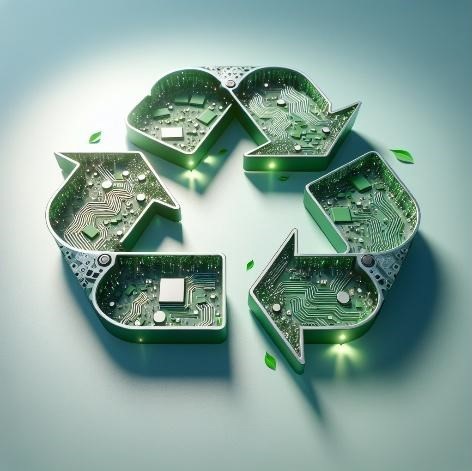
The electrification and digitalization of everyday life are leading to a rapidly growing volume of electronic waste (e-waste): since 2010, the global amount of e-waste has doubled to 62 million tons in 2022 – a trend that is becoming increasingly unsustainable, yet also harbours significant economic potential and touches on aspects of European autonomy with regard to materials. A major contributor are printed circuit boards (PCBs), which account for 3–6% of total e-waste by mass and are currently disposed of predominantly through landfilling or incineration.
The MAPEX project "Circular Electronics" addresses this challenge through the development of fully circular materials and assemblies. Through the close integration of chemistry, engineering, electrical engineering, and innovation management, circular printed circuit boards, organic semiconductors, and sensor systems are developed, tested, and optimized for reusability. Key areas of focus include novel dynamic polymer networks (vitrimers), which can be broken down into their basic building blocks during recycling, as well as biosynthetic high-performance fibres. Drawing on empirical methods, innovative strategies are developed and tested that enable researchers to leverage the freedom of fundamental research while simultaneously delivering concrete, short-term applicable results – such as use cases and circular business models – potentially involving industry and society. Through its interdisciplinary approach, "Circular Electronics" makes a significant contribution towards a more circular electronics industry.



Project Partners:
- Institute for Microsensors, -actuators and -systems (IMSAS), University of Bremen – Project lead, development of circular electronic assemblies and organic sensors (Prof. Dr. Björn Lüssem)
- Fraunhofer Institute for Manufacturing Technology and Advanced Materials (IFAM) – Development of circular polymer materials (Dr. Katharina Koschek)
- Fibre Institute Bremen e.V. (FIBRE) – Development of biosynthetic fibres and composite materials (Prof. Dr.-Ing. David May, Dr. Boris Marx)
- Faculty of Business Studies and Economics, Professorship of Business Administration, specialising in Technology and Innovation, University of Bremen – (A-)synchronicity and circular business models (Prof. Dr. Tobias Röth)
Associated Partners:
- Advanced Ceramics, University of Bremen – Ceramic functional materials and nanoparticles (Prof. Dr. Kurosch Rezwan)
- Hybrid Materials Interfaces Group (HMI), University of Bremen – Molecular modelling and simulation (Prof. Dr. Lucio Colombi Ciacchi)
- Center for Industrial Mathematics (ZeTeM), University of Bremen – Mathematical optimization and data-driven process modelling (Prof. Dr. Christof Büskens)