2026 - KOMSO Academy
Deep Learning Methods for Partial Differential Equations, November 30 & December 1, 2026

The Robert Bosch GmbH (Stuttgart), the Center for Industrial Mathematics (ZeTeM, University of Bremen), and the Committee for Mathematical Modeling, Simulation, and Optimization (KOMSO) are pleased to announce the fourth edition of the KOMSO Academy, dedicated to “Deep Learning Methods for Partial Differential Equations”.
The KOMSO Academy provides a platform for exchange on novel mathematical concepts relevant to industrial applications, for engineers, physicists, mathematicians, industry professionals, and anyone interested in deep learning for partial differential equations (PDEs).
Deep learning concepts for PDEs are rapidly evolving, and researchers and practitioners in this area face the challenge of selecting suitable architectures, loss terms, and training schemes for their specific problems. This workshop therefore aims to provide an overview of recent developments in the field. In addition, we will dedicate substantial time to hands- on training sessions, where we solve a variety of problems using Physics-Informed Neural Networks (PINNs) and tackle operator learning methods such as PCA-Nets and DeepONets.
The workshop is based on a collaboration with Robert Bosch GmbH and on a software toolbox developed for solving physical problems using deep learning. It will be complemented by invited talks from distinguished experts in academia and industry. We would very much like to welcome you in person in Renningen/Stuttgart. However, a limited number of online participation slots will be available for those unable to attend on site.
KOMSO Academy
The KOMSO Academy aims to address novel business and technology trends at an early stage of development. It brings together leading experts from industry and academia to discuss the current state of the art, as well as potentials, risks, and future developments. The program is open to short contributions from participants seeking feedback on their specific problems.
The present workshop focuses on deep learning concepts for solving partial differential equations and related parametric studies. We will host two external speakers presenting on advanced optimization schemes for faster training and on the use of deep learning in optimization processes. In addition, a concrete application for improving multiscale methods will be discussed, and reports on successful implementations in applied and industrial contexts will be presented.
The program also includes hands-on training using a dedicated software toolbox (to be announced later). In the training sessions, participants will have the opportunity to gain direct experience with solving prepared example problems using deep learning approaches. PDE-based parameter studies and parameter identification problems will be considered.
Invited Speaker & Organizers
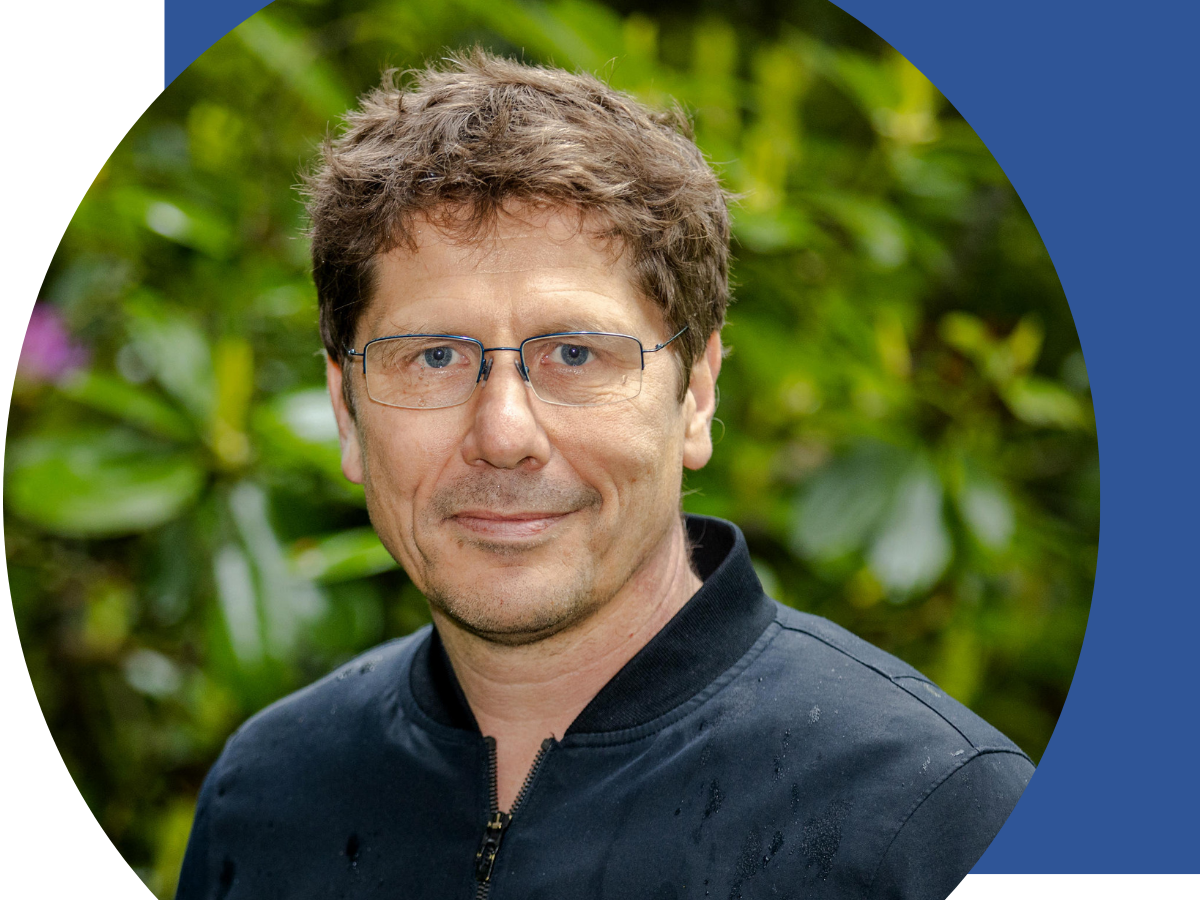
Hanno Gottschalk is an internationally leading expert for AI based generative modelling of technical processes. His research spans from theoretical investigations for stochastic AI models to real life applications such as modelling of turbulence. In this context he recently published a highly appreciated review on how generative models help to solve parameter identification problems. He is also the KOMSO representative for national AI initiatives. Moreover, he is highlighted by NVIDIA research as one of their main collaborators, e.g. he receives generous funding from the NVIDIA Academic Grant Program for Researcher.
Hanno Gottschalk received his PhD under the supervision of Sergio Albeverio (1999, Bochum) before spending PostDocs in Rome and Bonn. From 2011 – 2023 he was Professor for Stochastic at the Bergische Universität Wuppertal before joining the TU Berlin, where he holds the Werner-von-Siemens-Professorship for ‘Mathematical modelling of industrial lifecycles’.

Marius Zeinhofer is a postdoctoral fellow in Prof. Siddhartha Mishra’s research group at ETH Zurich.
His research focuses on developing geometric optimization methods for scientific machine learning applications, including physics-informed neural networks (PINNs), neural quantum states, and neural operators.
He is particularly recognized for his contributions to natural gradient methods for high-accuracy PINN training, as well as his numerical analysis of both PINNs and the deep Ritz method.
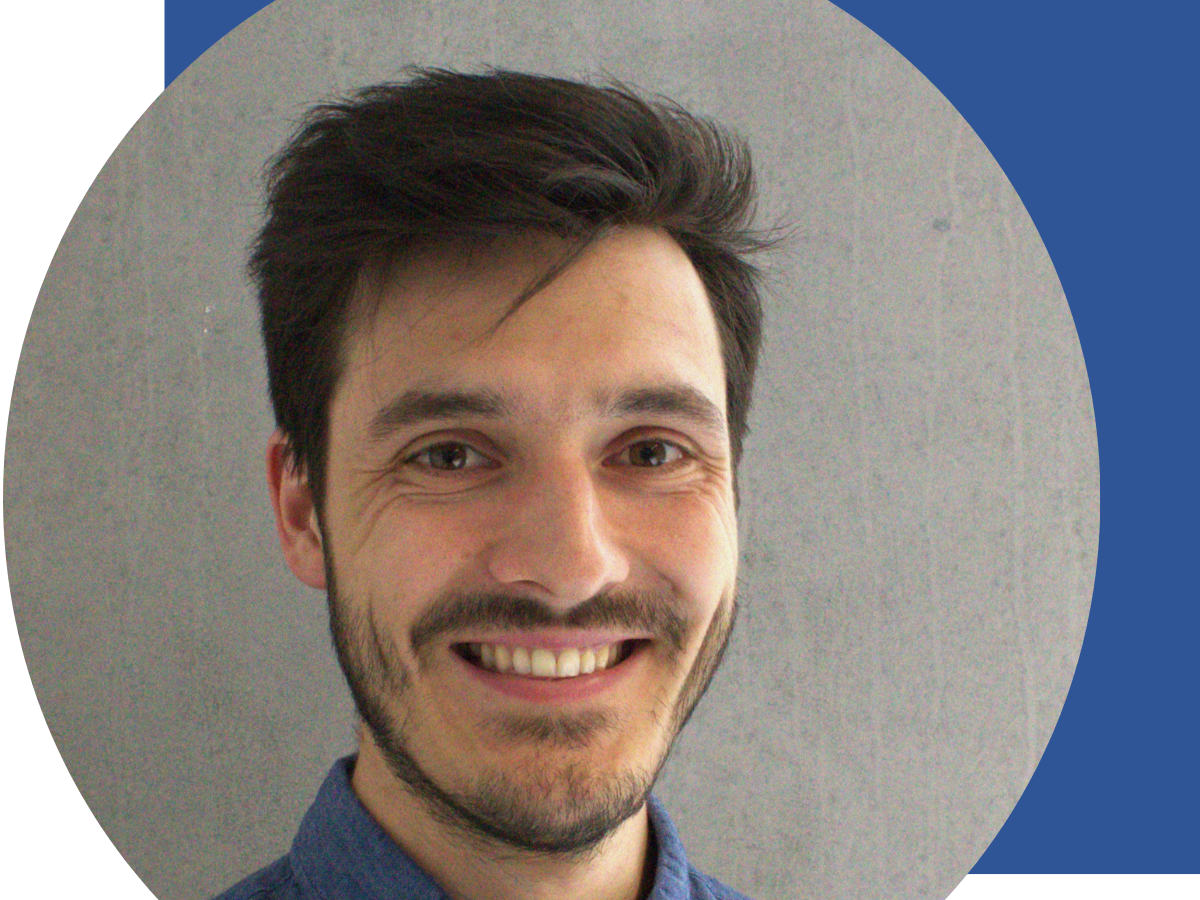
Julian Nürk is a PhD student at Bosch Research and Heidelberg University. His main research area is scientific machine learning for multiscale problems in the context of uncertainty quantification and virtual validation.
Working closely together with the research group of “Numerical Analysis and UQ” from Heidelberg University, led by Prof. Dr. Robert Scheichl, he focuses on enhancing advanced numerical multiscale methods with machine and operator learning.
During his Master’s he gained industry experience by various collaborations with BOSCH, applying math knowledge to real-world problems. He holds a Bachelor’s degree in Mathematics and a Master in Scientific Computing from Heidelberg University.

Uwe Iben is a Chief Expert for Applied Mathematics at Bosch Research.
His main research aeras includes AI methods for solving of ODEs and PDEs as surrogate models. He has joined the Robert Bosch GmbH in 1999 as a simulation engineer. He worked 15 years on the field of multi-phase flow and cavitation as a project leader and Chief expert. From 2016 till 2020 he became the head of Research and Technology Offices in Saint Petersburg/Russia.
Dr. Iben studied mathematics at Moscow State University and Technical University of Dresden. After his PhD in the field of numerical mathematics, he worked as a PostDoc at Otto-von-Guericke University, Magdeburg. In 2003, he received his doctorate in the field of modeling of cavitating flow phenomena from Otto-von-Guericke University Magdeburg, Germany. He became an honorary professor at the University of Stuttgart in 2017 where he gives lectures on multi-phase flow phenomena.

Peter Maass (Professor for Applied Mathematics at the Center for Industrial Mathematics at University of Bremen, ZeTeM). His main research areas include inverse problems, parameter identification, and since several years deep learning.
Prof. Maass studied mathematics in Karlsruhe, Cambridge and Heidelberg and obtained his doctorate in 1988 from TU Berlin as well as his habilitation in mathematics from Saarland University in 1993. Peter Maass was a full professor at Potsdam University from 1993 -1999 before becoming director of ZeTeM.
He spent several longterm research visits as guest professor or researcher at leading international universities including Paris, Berkeley, Boston and Cambridge.
Workshop Team University of Bremen

Nick Heilenkötter
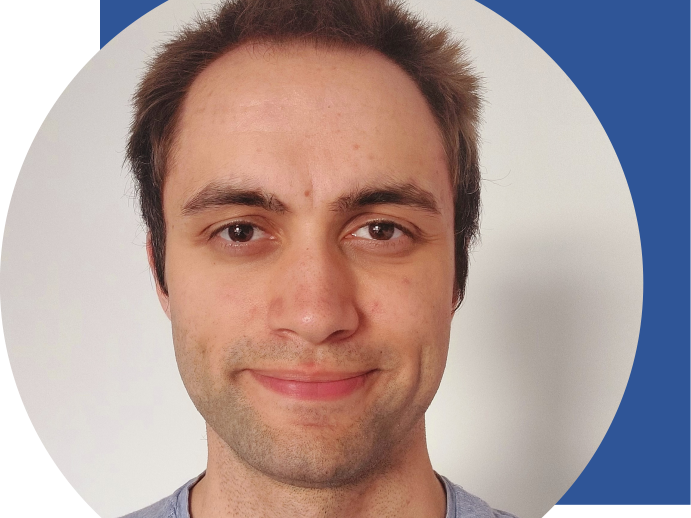
Tom Freudenberg
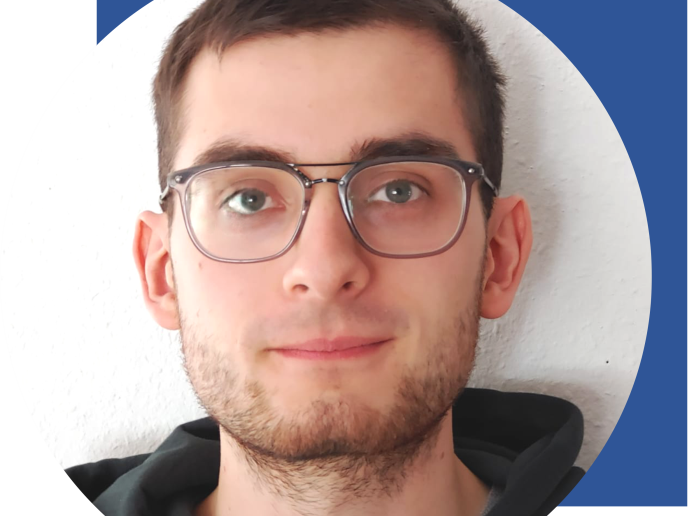
Janek Gödeke
The software library TorchPhysics was originally developed by Tom Freudenberg and Nick Heilenkötter (University of Bremen) within a modeling seminar in collaboration with the Centre for Industrial Mathematics and Robert Bosch GmbH. It is maintained and extended by Janek Gödeke, Tom Freudenberg, and Nick Heilenkötter together with a research team at Bosch led by Prof. Dr. Uwe Iben. At the University of Bremen, the team has recently initiated the development of a new software framework aimed at further improving the usability of deep learning approaches for PDEs.
The work is driven by a wide range of applications arising both in industrial research and in the field of Industrial Mathematics.
Training Sessions
Within the KOMSO Academy, we offer a hands-on workshop on deep learning approaches for partial differential equations (PDEs) and their practical implementation in computational frameworks.
The course begins with an introduction to fundamental concepts for solving PDEs using deep learning techniques. Using classical benchmark problems such as Poisson and Darcy flow equations, participants will learn how physics-informed loss functions can incorporate physical laws directly into neural network training. Alongside these foundations, we emphasize hands-on implementation strategies within a flexible software environment that supports a wide variety of PDE-related problems, including those defined on complex and time-dependent domains.
Building on these basics, the course then introduces operator learning methods for PDEs, which are particularly suited for parametric studies and parameter identification tasks. Participants will explore modern architectures such as PCA-based networks, DeepONets, and Fourier Neural Operators (FNOs), as well as their variants, gaining insight into both their theoretical foundations and their practical realization.
In the final session, all participants come together to discuss their own PDE-related challenges. This interactive format allows for an exchange of ideas on suitable deep learning approaches and implementation strategies for specific applications. Participants are encouraged to bring their own problems for discussion.
Place and Agenda
The KOMSO Academy will take place at the Bosch Forschungscampus, Renningen/Stuttgart.
For more detailed information about arriving by car or by public transportation from Stuttgart airport or Stuttgart main station, click here.
Online participation is possible for a limited number of participants and the dial-in data will be provided by E-mail.
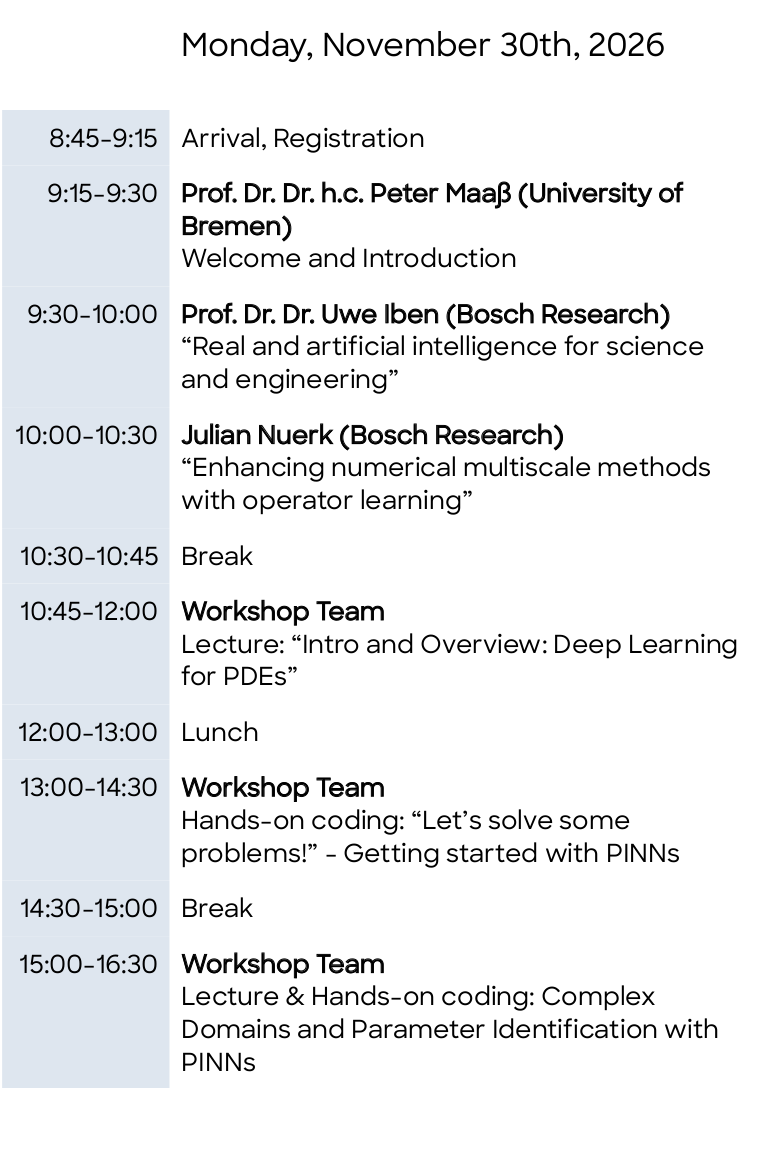
Conference Dinner, November 30
Included in the conference fee for on-site attendees.
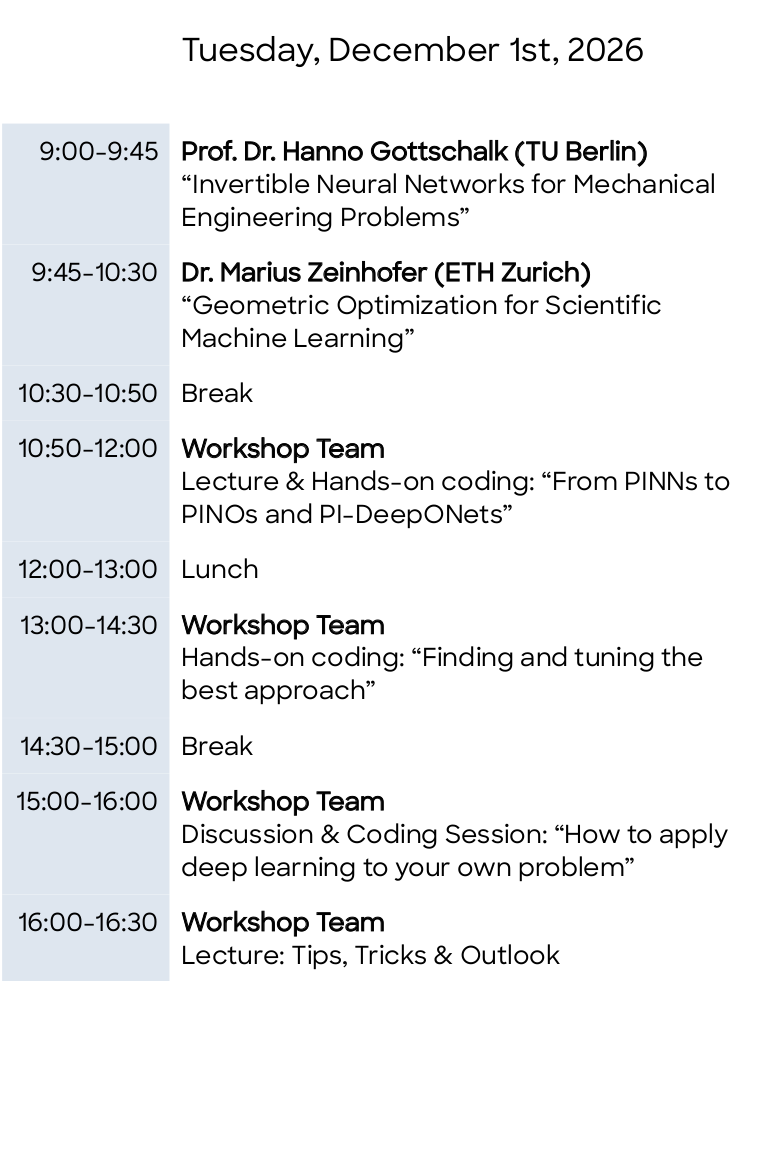
Organizers & Registration
Organizers:
Prof. Dr. Dr. Uwe Iben, Robert Bosch GmbH
Prof. Dr. Dr. h.c. Peter Maaß, University of Bremen
Registration:
Date: November 30 & December 1, 2026
Place: Renningen/Stuttgart or virtual
Registration fee for industry: 500 € (online 400 €) + VAT
Early-Bird until July 30: 400 € (online 300 €) + VAT
Registration fee for academia: 200 € (online 150 €) incl. VAT
(On-site registration fee includes the conference dinner, November 30)
Registration Deadline: October 30, 2026
Employees of Robert Bosch GmbH attend free. A 70 € catering fee (including conference dinner) applies for in-person attendance.
For all participants: For the hands-on parts of the course, it is only required to bring your own Laptop. We will provide a connection to the servers of the University of Bremen on which the required software is already installed.
For registration please send an e-mail to the local organization committee.