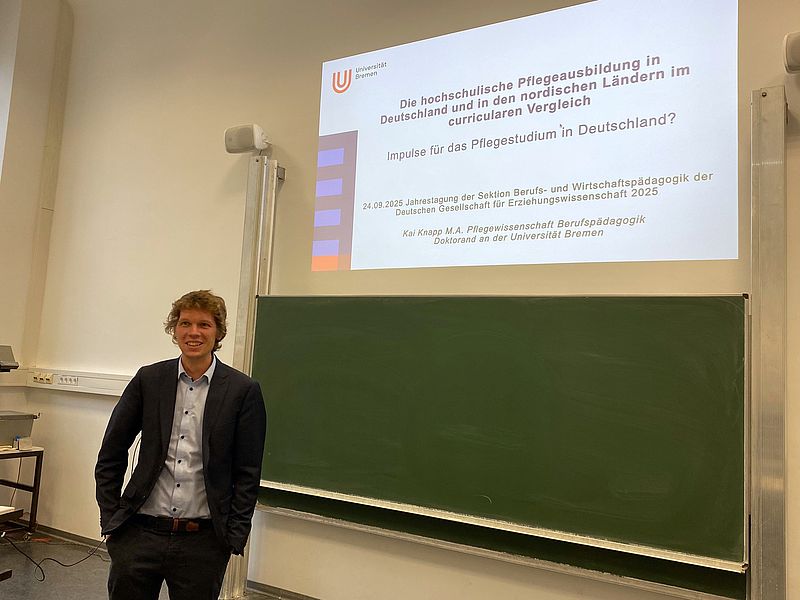
As part of the Early Career Researcher Program, Kai Knapp presented the current status of his dissertation project entitled “A Curricular Comparison of Higher Education Nursing Programs in Germany and the Nordic Countries – Implications for Nursing Studies in Germany?” The forum serves as a platform for doctoral students to exchange ideas and discuss their doctoral projects.
The project involves a curricular analysis comparing nursing degree programs in the Nordic countries (Iceland, Sweden, Norway, Finland, and Denmark) with those in Germany. The comparison was based on the results of a research project funded by the Federal Institute for Vocational Education and Training (BIBB) that has already been completed
). The comparison showed that, in contrast to degree programs in Germany, degree programs in the Nordic countries have more similarities, for example in terms of the standard periods of study chosen. However, it remains unclear what potential or disadvantages the harmonization that has taken place in the Nordic countries entails. In the further course of the research, an international interview study will be conducted in order to gain deeper insight into the harmonization processes. The subsequent discussion was particularly interesting and enriching, opening up new perspectives and offering valuable suggestions for further data collection.
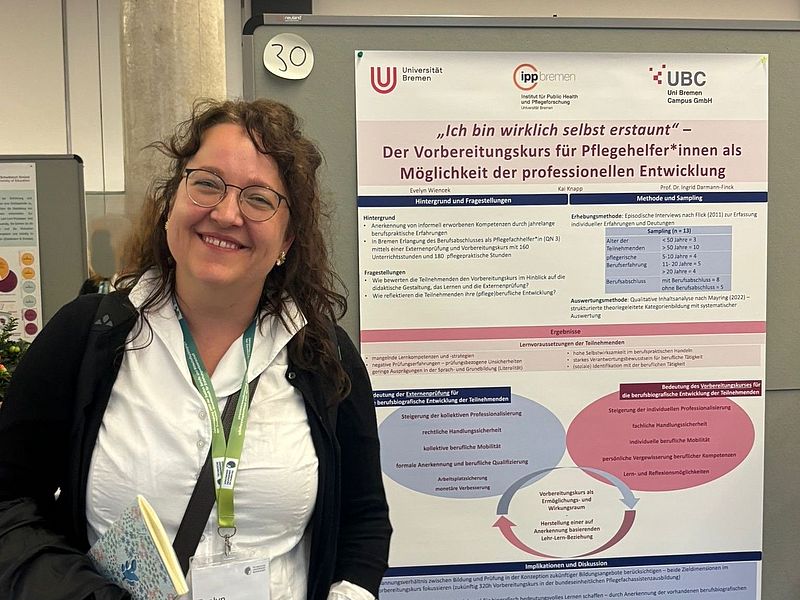
Evelyn Wiencek, Prof. Dr. Ingrid Darmann-Finck, and Kai Knapp presented a poster with the first results from the research project “Evaluation of the External Examination in Nursing Assistance in Bremen.” Data was collected using guided episodic interviews with 13 participants from three different preparatory courses for the external examination. The study concludes that the preparatory course and the external examination not only lead to the acquisition of a vocational qualification, but the results also indicate that educational opportunities such as the preparatory course represent biographically significant learning spaces for critically reflecting on one's own skills and acquiring professional expertise.
Larissa Fenker presented the results of an analysis of group discussions with nursing teachers from the STePs project at the symposium Nursing Education and Care Professions in the Context of Vocational Training in a Migration Society, led by Prof. Dr. Ingrid Darmann-Finck and Prof. Dr. Karin Reiber. The interdisciplinary research and development project Strengthening Language Participation in Nursing Education – School and Nursing Practice as Learning Opportunities (STePs), funded by the BMBF, aims to support multilingual trainees with a migration background in successfully completing their nursing education through a systematic language-building approach to nursing education. The article Between Control and Participation: The Importance of Relationship Building for Promoting Language Participation in Nursing Education focused on practices in schools as places of learning and shared experiences of teachers with nursing education in the context of multilingualism.