

Homepage

News

Important Step in Alzheimer’s Research

Immense research success in cell biology: Professor Janine Kirstein’s working group at the University of Bremen has taken an important step towards better understanding Alzheimer’s. The decisive nerve cells, in which the disease takes hold, were found in threadworms.

Dementia illnesses are a great strain, especially for older people. According to information from the pharmaceutical manufacturer Novartis, around one million people in Germany are affected; Alzheimer’s makes up around 70 percent. As people are becoming older, the growth rate is increasing exponentially. Research findings carry hope – and one significant finding comes from the University of Bremen. The cell biologist Professor Janine Kirstein and her working group have determined the “nerve cell 0” in threadworms – thus the nerve cell in which Alzheimer’s disease begins. As the findings can be transferred to humans, more expedient approaches for the avoidance or slowing down of the disease can now be developed.

“In the human ageing process, increasing numbers of defects occur in our nerve cells,” explains the Bremen university lecturer. “With Alzheimer’s, there is an increasing number of misfolded proteins, which them clump together and create elongated, rope-like structures, for example.” These “rope-like structures” can attack large areas of the brain and finally lead to diseases such as Alzheimer’s or Parkinson’s – and in the worst case to dementia with all the connected cognitive impairments. 

“Nerve Cell 0” Identified

In the frame of the research into threadworms, Janine Kirstein and her working group succeeded in making this process visible and above all, in identifying the “starting point” of the illness – the “nerve cell 0.” “Threadworms are particularly suitable as they are identical to humans on the molecular level. They are also transparent, which is how the processes can be made visible using fluorescent coloring.” During the research, the group discovered the cells in which the clumping first occurs.

One of the advantages is that the threadworm’s life cycle only spans one month from birth to death. “Carrying such research out on humans is prohibited on ethical grounds and the cycle would still take two years even if mice were to be used,” according to Janine Kirstein. In contrast, the processes are quick and can be observed on a daily basis in threadworms.

Research Findings Suggest Marker Development

The results of the research carried out by the Bremen working group now allow for the expedient focusing on the nerve cells in humans, in which degenerative neurological diseases such as Alzheimer’s start. “For example, one could develop a marker that allows for the inference of whether the degeneration has already started or not,” states the professor. “The quicker one could then react in order to avoid further consequences.”

The working group published their findings in Progress in Neurobiology, the leading neurobiological journal. Subsequently, Janine Kirstein and her colleagues received short-notice start-up financing of 50,000 euros from the Alzheimer Forschung Initiative e.V. The funds are to be used for the development of further projects.

Scientific Background:

Alzheimer’s disease stems from the fibrillization of amyloid-beta peptides and tau proteins. Amyloid-beta peptides occur in all humans but only a relatively small proportion suffer from Alzheimer’s. The largest risk factor is age. In over-80-year-olds, the proportion of those suffering from Alzheimer’s is 20%. This number rises to 30% to 50% for those over 85 years of age. The individual molecules are harmless. It is only when they combine that they can create toxic aggregates.

In the past years, it has been shown that the deposits of the amyloid-beta peptide can disperse throughout the whole brain. If this cascade gets going, it is not possible to stop or even reverse it. To date it was only known that the first fibrillar amyloid-beta peptide deposits occur in the brain’s cerebral cortex and hippocampus. However, it was unknown where the aggregation begins exactly.

Janine Kirstein’s working group have now successfully generated a new animal model of Alzheimer’s disease in the Caenorhabditis elegans threadworm. Using this model, her colleagues have been able to show that the amyloid-beta peptide aggregation begins in exactly six nerve cells – the IL2 neurons – and then systematically spreads to all nerve cells from there.

Is it now possible to suppress the transfer to the other nerve cells? The nematode is easy to access on a genetic level and allows for cell-specific manipulation. Kirstein’s group has shown that an expedient inhibition of the amyloid-beta aggregation in the IL2 neurons actually slows down the aggregation cascade and the transfer to other neurons. Additionally, a reduction of the toxicity and an increase in the median lifespan were observed.

Can these findings be applied to far more complex model systems, such as mice? That remains to be seen. The identified IL2 neurons use the same neurotransmitters (acetylcholine) as the majority of the neurons in the areas of the brain that are the first to be affected by the amyloid-beta aggregation. It is not possible to directly match the homogenous neurons. However, the Caenorhabditis elegans data helps a great deal, as it is now possible to specifically search for the “start” neurons in more complex systems in order to intervene at an early stage and subsequently hinder the aggregation cascade. Thus, these findings are both highly relevant for diagnostics and for the development of new therapy approaches.

The Next Steps

What makes the IL2 neurons so susceptible to amyloid-beta aggregation? What makes IL2 neurons different to other neurons? How does the transfer and spread of the amyloid-beta aggregation between nerve cells works? Can we activate our own protection systems, such as molecular chaperones and proteases, in order to inhibit amyloid-beta aggregation?
 

Original Publication:

Novel amyloid-beta pathology C. elegans model reveals distinct neurons as seeds of pathogenicity
Gallrein C, Iburg M, Michelberger T, Koçak A, Puchkov D, Liu F, Ayala Mariscal S, Nayak T, Kaminski Schierle G, Kirstein J
Progress in Neurobiology
www.sciencedirect.com/science/article/pii/S0301008220301623

Further Information:

https://www.uni-bremen.de/en/zellbiologie/
www.uni-bremen.de/en/

Contact:

Prof. Dr. Janine Kirstein
Professor of Cell Biology
Faculty of Biology / Chemistry
University of Bremen
Tel.: +49 421 218-62880
Email: kirsteinprotect me ?!uni-bremenprotect me ?!.de
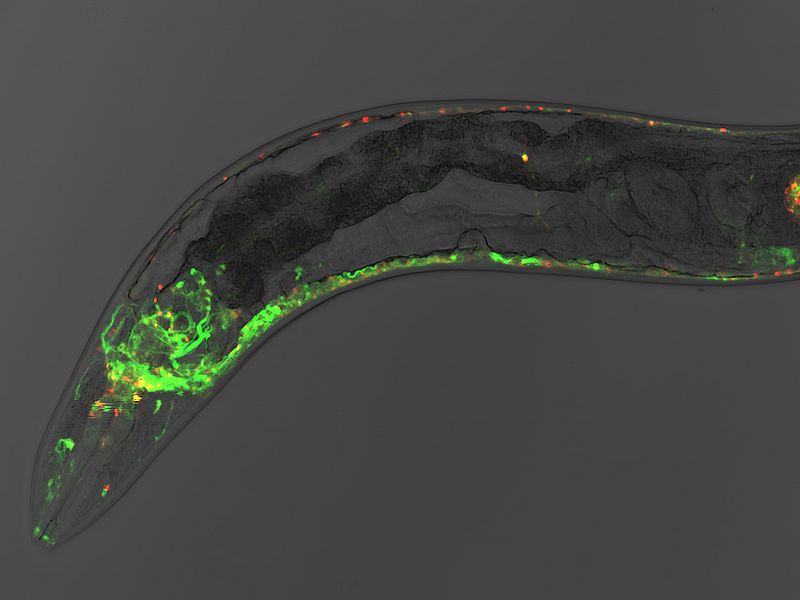
 

Fadenwurm
The Caenorhabditis elegans threadworm is identical to humans on the molecular level. The worm plays an important role in research into Alzheimer’s disease.

Events

06. Jan
Mittagskonzert: „Befreiung naht!“ – Eigene Kompositionen und Texte zum CD-Release
Theatersaal der Universität
12:30 12:55
More
07. Jan
Rahel Fischbach (William & Mary), "Making Sense of Violence in the Qur'an: A Hermeneutic-Aesthetic Approach"
UNICOM, InIIS 7.2210
12:00 13:30
More
08. Jan
The Martian Mindset: A Scarcity-Driven Engineering Paradigm
ZARM Universität Bremen - Am Fallturm, 2 - Raum 1730
14:00 15:00
More
08. Jan
Gereon Niedner-Schatteburg (Univrsität Kaiserslautern)
Hörsaal H3, Geb. NW1, Otto-Hahn-Allee 1, 28359 Bremen
16:00 17:00
More
09.05. Jan Jun
YUFE Ideas Lab Incubation Program
Blended: Online / Madrid
All day
More
09. Jan
Aus den Akten auf die Bühne - Karrieren in Bremen nach 1945 - Kurt A. Becher – Käthe Popall – Alfred Ries
Theater am Leibnizplatz
19:30 22:00
More
11. Jan
LiteraTour Nord: Reading tour 2025/26 – Katerina Poladjan
Theater Bremen, Goetheplatz 1-3
20:00 21:30
More
13. Jan
Universität im Gespräch
GW2, B3009
10:00 12:00
More
13. Jan
Mittagskonzert: Vier Hände, viele Klangwelten
Theatersaal der Universität
12:30 12:55
More
13. Jan
Benjamin Goossen (Boston) | Mennonites and Lebensraum. Situating a Christian Denomination in Hitler‘s Empire
Online
18:00 20:00
More
14. Jan
Vortrag | Ringvorlesung Gefährdete Demokratie | WOC & Profs gegen Rechts Rahel Jaeggi (Berlin): Regressive Demokratie – Regressive Moderne
Rotunde
18:15 20:00
More
14. Jan
Profs gegen Rechts / Prof. Dr. Rahel Jaeggi (Humboldt Universität zu Berlin): Regressive Demokratie – Regressive Moderne
Rotunde/Cartesium
18:15 19:45
More
15. Jan
Migrantische Arbeitskämpfe und Machtressourcen in der Fleischindustrie
Forum am Domshof
16:00 18:00
More
19. Jan
Heidi Hein-Kircher (Herne/Bochum) | Die Sittenreformbewegung in Polen als Teil einer europäischen Lebensreformbewegung in der ersten Hälfte des 20. Jahrhunderts
IW3 0330
18:00 20:00
More
20. Jan
Mittagskonzert: Alle Wege führen zum Tango
Theatersaal der Universität
12:30 12:55
More
20. Jan
studio Vortrag: Regine Heß (München) "Wer wohnt wo auf großen Ausstellungen? Ungleiche (Wohn-)Modelle zeigen"
18:00 20:00
More
21. Jan
Vortrag und Buchdiskussion | WOC Agora #12 Florian Sprenger (Bochum): Ich-Sagen. Genealogie der Situiertheit
Cartesium Rotunde U Bremen
18:15 19:45
More
21. Jan
Aus den Akten auf die Bühne - Geflüchtet, unerwünscht, abgeschoben. "Lästige Ausländer" in der Weimarer Republik
Theater am Leibnizplatz
19:30 22:00
More
22. Jan
SALON TIER Vortrag: Elisabeth Luggauer (Stadtanthropologin, Humboldt-Universität zu Berlin) Multispezies-Konvivialitäten: Wie Straßenhunde Stadt (mit)gestalten
18:00 20:00
More
23. Jan
YUFE R&R Webinar Series: Work Well-Being in Academia
Online
10:00 12:00
More
25. Jan
LiteraTour Nord: Reading tour 2025/26 – Annett Gröschner
Theater Bremen, Goetheplatz 1-3
20:00 21:30
More
26. Jan
Seth Bernstein (Gainesville) | Big Brother Where Art Thou? Police Intelligence and Artificial Intelligence in Soviet Secret Police Archives
Online
18:00 20:00
More
27. Jan
Mittagskonzert: Dos a Cu4tro: "Solo Solare" – Ein Portraitkonzert
Theatersaal der Universität
12:30 12:55
More
28. Jan
Das Goldene Plietsch 2026
Forum am Domshof
16:30 Open End
More
01. Feb
„In das Unbekannte“ – Semesterabschlusskonzert von Orchester und Chor der Universität Bremen
Theatersaal der Universität
17:00 19:00
More
12. Feb
Aus den Akten auf die Bühne - "Im Lager hat man auch mich zum Verbrecher gemacht" - Margarete Ries: Vom "asozialen" Häftling in Ravensbrück zum Kapo in Auschwitz
Theater am Leibnizplatz
19:30 22:00
More
18.20. Feb
Research – Attitude – Activism? Inclusion Research between Educational Utopia and System Conformity
University of Bremen
All day
More
24. Feb
Bremer Ocean Day
Campus Uni Bremen, Hörsaalgebäude (Keksdose)
09:30 12:30
More
24. Feb
Info-Veranstaltung zum Übergang vom Bachelor (Lehramt) in den Master of Education
Zoom
13:00 14:00
More
24. Feb
Aus den Akten auf die Bühne - Karrieren in Bremen nach 1945 - Kurt A. Becher – Käthe Popall – Alfred Ries
Theater am Leibnizplatz
19:00 21:30
More
25.27. Feb
International Conference on Dynamics in Logistics (LDIC 2026)
Mehrzweckhochhaus (MZH), Bibliothekstraße 5, 28359 Bremen
All day
More
02. Mar
Aus den Akten auf die Bühne - Reichsführers gehorsamster Becher: Vom SS-Standartenführer zum Millionär
Theater am Leibnizplatz
19:00 21:30
More
03. Mar
Aus den Akten auf die Bühne – Menschen auf der Flucht - Anna Seghers "Transit"
Falstaff im Theater am Leibnizplatz
19:30 21:00
More
09. Apr
Prof. Dr. Matthias Bartelmann (Universität Heidelberg): Universalität kosmischer Strukturen
Hörsaal H3, Geb. NW1, Otto-Hahn-Allee 1, 28359 Bremen
16:00 17:00
More
27. Apr
Info-Veranstaltung: Lehramt studieren an der Uni Bremen
Zoom
15:30 17:00
More
13. Jun
OPEN CAMPUS
Campus der Universität Bremen
All day
More
13. Jun
Open Campus der Universität Bremen
All day
More
15. Jun
Gesellschaftliche Unterschiede: Warum wir uns voneinander untrscheiden und warum das (manchmal) wichtig ist
Hanse-Wissenschaftskolleg, Lehmkuhlenbusch 4, 27753 Delmenhorst
19:30 21:00
More
22.26. Jun
Sommerakademie
Universität Bremen
All day
More
22. Jun
Info-Veranstaltung: Lehramt studieren an der Uni Bremen
Zoom
15:30 17:00
More
24. Jun
Info-Tag für Studieninteressierte 2026
Campus der Uni Bremen
08:30 16:00
More
17. Aug
Bernsteine: Zeitkapseln der Evolution
Hanse-Wissenschaftskolleg, Lehmkuhlenbusch 4, 27753 Delmenhorst
19:30 21:00
More
03. Sep
Warum wir wählen, was wir wählen: Unser Wahlverhalten in unsicheren Zeiten
VHS Delmenhorst, Am Turbinenhaus11, 27749 Delmenhorst
19:30 21:00
More
05. Oct
Wahlmanipulation im digitalen Zeitalter: Wo liegen die Gefahren?
Hanse-Wissenschaftskolleg, Lehmkuhlenbusch 4, 27753 Delmenhorst
19:30 21:00
More
02. Nov
Wölfe in Niedersachsen
Hanse-Wissenschaftskolleg, Lehmkuhlenbusch 4, 27753 Delmenhorst
19:30 21:00
More
All Events

Studies

Students walking along the MZH and chatting

Studying at the University of Bremen

Whether it be the compact campus, the diverse study programs on offer, or the green cycling city – a degree at the University of Bremen has a lot to offer.

You can choose from a broad range of degree program at the University of Bremen:

  • more than 100 bachelor’s and master’s degree programs
  • the state examination in law
  • international degree courses and further training offers

Profile

The University of Bremen is one of Germany’s medium-sized universities. In its mission statement, the university prioritizes:

Academic Consultation

Visit the following points of contact for information on studying:

Applying to Study

We provide comprehensive and detailed information on applications and enrollment for the following areas:

All about Research

Test tubes with different coloured liquids.

High Level of Third-Party Funding

A great strength of the University of Bremen is its considerable success in the acquisition of third-party funds, both in individual as well as in collaborative research. The German Research Foundation (DFG) is the largest provider of third-party finance: Besides the MARUM Cluster of Excellence, the University of Bremen is currently involved in no less than seven Collaborative Research Centers, as well as a number of research groups and priority programs.

Zwei Personen bei der gemeinsamen Arbeit im Labor.

Strategic Promotion of Talent

The targeted promotion of young talent, unlocking potential, and early independence are among the guiding principles of the University of Bremen. We offer intensive support to young academics in six DFG research training groups, numerous junior research groups and also through doctoral programs offered in cooperation with non-university research institutions.

Zwei Lehrende arbeiten vor Zuhörern an einem Flipchart.

Lifelong Learning

The University of Bremen is a place of lifelong learning. With our offers of continuing education we enable you to acquire knowledge of cutting-edge research. Discover the wide range of our offers and benefit from the unique combination of practice-oriented learning and innovation.

Facets of the University of Bremen

Diversity

The diversity of our students and staff is both a framework as well as a prerequisite for high quality in research and teaching. As a cross-sectional priority and central profiling feature, we take account of diversity in our teaching and learning formats, in the structure of degree programs, and in the content of research and teaching. Moreover, diversity orientation and equal opportunity also guide us in the composition of teams and the design of counseling.   

International

Internationality is a strategic profiling objective of the University of Bremen. In keeping with our self-image as an international university, we see internationalization as a process that extends into all areas of the university – whether research, studies or administration. People from more than 100 nations enrich campus life. We are networked worldwide. In close cooperation with our partners, we work on the advancement of knowledge and finding solutions to global challenges.

Sustainability

The University of Bremen has been committed to sustainable development for years. Numerous projects and measures exist in the areas of research, teaching, operations, governance, and transfer, supporting the implementation of the 17 Sustainable Development Goals (SDGs) by the United Nations. Among them are the outstanding EMAS environmental management program, the university’s promotion of social sustainability as well as several research institutions with a focus on sustainability

Have you Heard of...?

There is a lot to be discovered on campus. What’s behind all those doors? up2date. online magazine knocks on some of them to find out. Welcome to a slightly different tour of the campus.

A man in front of a green screen is looking into the camera.

Have You Heard of... the ZMML?

Learning platform, testing center, online courses, lecture halls with opencast technology, a film studio, and much more – when you see digital teaching in action on campus, the ZMML is usually behind it.

A gloved hand runs a brush through the crease of a book.

Have You Heard of... the SuUB’s Restoration Workshop?

Equipped with an array of tools that includes brushes, book support wedges, and soot sponges, the restoration workshop saves historical books from decay. Welcome to a slightly different tour of the campus!

  • Go to page: aaq Akkreditierung
  • Go to page: Gütesiegel des Deutschen Hochschulverbands
  • Go to page: EMAS Zertifizierung für geprüftes Umweltmanagement
  • Go to page: Zertifikat audit familiengerechte hochschule
  • Go to page: Audit „Internationalisierung der Hochschulen“ der HRK
  • Go to page: Logo Audit "Vielfalt gestalten" des Stifterverbandes
  • Go to page: CHE Ranking
  • Go to page: Siegel Gründungsradar des Stifterverbandes
  • Go to page: Logo of the HR Excellence in Research Award