
Research Infrastructure

The University of Bremen provides its researchers with a high-performance, forward-looking research infrastructure to advance cutting-edge research at an international level. Something you can see from a distance is Bremen’s Drop Tower, the only one of its kind in the world, which enables experiments in zero gravity. Yet in the quiet corners of the sprawling campus, too, you can find state-of-the-art technologies, unique collections, and exclusive support services for researchers. This page provides an overview.

International Core Repository
MARUM – Center for Marine Environmental Sciences is home to one of the three international core repositories currently operated by the International Ocean Drilling Programme (IODP³). Bremen’s core repository currently archives over 193 kilometers of drill cores from multiple geological eras and 106 expeditions – including samples from the Atlantic Ocean, the Arctic Ocean, the Mediterranean Sea, the Black Sea, and the Baltic Sea. At this scale, the Bremen core repository surpasses the two other IODP core repositories in the United States and Japan.
Every year, around 200 researchers work at the Bremen repository. More than 50,000 samples are taken from the drill cores each year, both by visitors and by repository staff. Thanks to the visitors and the active involvement of multiple MARUM working groups in the International Ocean Drilling Programme, there is ongoing exchange with leading geoscience research institutes around the world. In addition to sediment samples, scientists around the world can also request frozen microbiological samples from the seafloor for research purposes.
find out more: International Core Repository“In the fields of climate and marine sciences, we are on a par with leading international institutions.”
Dr. Kai-Uwe Hinrichs, Professor of Organic Geochemistry

Center for Deep-Sea Research
The Center for Deep-Sea Research opened on the University of Bremen campus in the spring of 2025. Spread across 4,000 square meters, it brings together various academic disciplines at MARUM – Center for Marine Environmental Sciences to closely integrate their research with the development of new technologies. The goal is to conduct interdisciplinary research on deep-sea processes, including gaining a better understanding of the biological, chemical, geological, and physical interactions in the deep ocean and on the ocean floor. These processes have a significant impact on the climate system and the global carbon cycle; however, many aspects of them remain poorly understood.
For their research, the scientists have access to highly specialized laboratories as well as a facility for developing and maintaining large-scale marine equipment. In addition, there is a cold storage facility that serves as an extension of the core storage facility for the International Ocean Drilling Programme.
find out more: Center for Deep-Sea Research“The research conducted here will not only expand our understanding of the deep sea, but also help with the development of sustainable solutions to the challenges facing our planet.”
Professor Jutta Günther, President of the University of Bremen
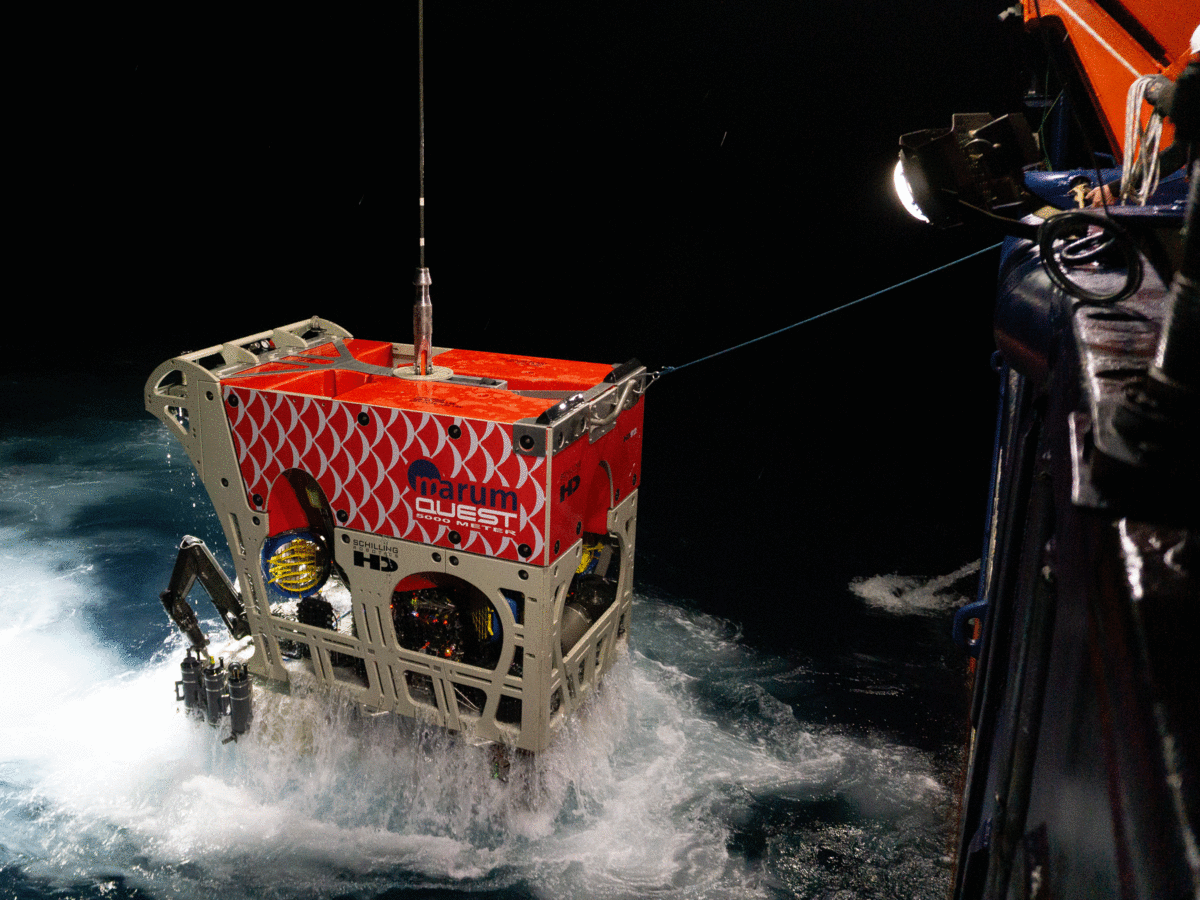
MARUM-QUEST 5000 Remotely Operated Vehicle
The MARUM-QUEST 5000 underwater robot is used on national and international research vessels around the world for scientific sampling and data collection in deep-sea research. It has been in service since 2025 as the successor to the MARUM-QUEST 4000 remotely operated vehicle (ROV) and features increased payload capacity, improved data transmission, more powerful hydraulics, and an extended diving depth of up to 5,000 meters.
When the predecessor, the MARUM-QUEST 4000, entered service in 2003, it was the first ROV of its class in Germany and was extensively modified at MARUM for scientific applications. It completed 490 successful dives on more than 42 expeditions and was a central component of German deep-sea research for more than two decades.
find out more: MARUM-QUEST 5000 Remotely Operated Vehicle
Drop Tower
At 146 meters tall, the Drop Tower is the most striking building on the University of Bremen campus. The Center of Applied Space Technology and Microgravity (ZARM) has operated it since 1990 as a facility for conducting short-term experiments in microgravity. For an experiment in the Drop Tower, the scientists make use of a simple fundamental principle of physics: In free fall, all objects are virtually weightless.
The test capsule is hoisted up into the vacuum environment in the approximately 120-meter-high drop tube and then released. Alternatively, it is launched by a globally unique catapult system all the way up to the top of the drop tube and then caught again. Up to three times a day, the experiments are subjected to a state of weightlessness equivalent to just one-millionth of Earth's gravitational pull.
This exceptionally high quality is achieved because the free fall takes place in a vacuum. Before conducting a microgravity experiment, 18 high-performance pumps create a vacuum inside the 120-meter-high drop tube, thereby eliminating air resistance. The catapult system enables an experiment duration of 9.3 seconds, which is unparalleled anywhere else in the world.
find out more: Drop Tower
GraviTower
Since 2022, the Bremen Drop Tower has been supplemented by the “GraviTower Bremen Pro” as a second microgravity laboratory. The 16-meter-high laboratory is the next-generation drop tower system. The advantage it has over the large drop tower is that it does not need to generate a vacuum in the GraviTower for zero gravity. This means that the tower allows for significantly more runs in a short period of time. Up to 20 experiments per hour can be conducted without problem, with each lasting up to 2.5 seconds in zero gravity. In addition to its microgravity mode, the GraviTower allows experiments to be conducted under partial gravity conditions, such as those found on the Moon or Mars.
All Drop Tower experiment modules are compatible with the GraviTower, allowing for easy switching between operating modes (Drop Tower, catapult, or GraviTower).
find out more: GraviTower“At ZARM, we operate unique research laboratories that are used by scientists from all over the world. For experiments simulating weightlessness on Earth, the Bremen Drop Tower offers the longest experiment duration, while the GraviTower provides gravitational conditions ranging from the weightlessness of space to the surface of Mars, the Moon, or asteroids – and does so with a very high repetition rate.”
Dieter Bischoff, Project Engineer at the ZARM Drop Tower operating company

Clean Rooms
The Institute for Microsensors, -actuators, and -systems (IMSAS) has two ISO Class 6 clean rooms with a total area of 900 m². They are designed for the pre- and post-processing of 100mm and 150mm wafers. The facilities enable all standard MEMS fabrication processes, including photolithography, thermal processing, physical and chemical deposition processes, dry and wet etching techniques, electroplating, wafer bonding, and chemical-mechanical polishing.
ISO Class 6 clean rooms ensure a controlled environment at a moderate cleanliness level. According to ISO 14644-1, a maximum of 35,200 particles ≥0.5 µm per cubic meter of air are permitted in this class, which corresponds to a level of cleanliness approximately 100 times higher than that of typical ambient air. Because of this level of cleanliness, ISO Class 6 environments are preferred for process steps in which particulate contamination could compromise the functionality or reliability of microtechnological and high-precision components. Typical areas of application include materials science, nanotechnology, and aerospace engineering, among others.
find out more: Clean Rooms
Robotics Laboratory at the Institute for Artificial Intelligence (IAI)
The Robotics Laboratory consists of two labs that resemble apartments – for example, they feature a kitchen and a dining area – and are used for research involving robotic systems in a household-like environment. The laboratory is used for purposes such as the interdisciplinary Collaborative Research Centre “Everyday Activity Science and Engineering” (EASE).
The project is investigating how robotic systems might perform complex everyday tasks, such as cooking, with the same dexterity as humans. With the help of the laboratory, it is possible to explore many aspects of human and robotic movement patterns and problem-solving strategies related to household tasks. The Robotics Laboratory and the Virtual Research and Training Building are among the leading AI-based robotics facilities in Europe.
find out more: Robotics Laboratory at the Institute for Artificial Intelligence (IAI)
Virtual Research and Training Building (ViB)
The Virtual Research and Training Building (ViB) is an open, digital research facility operated by the Joint Research Center on Cooperative and Cognition-enabled AI (CoAI JRC) at the Universities of Bremen, Bielefeld, and Paderborn. It enables researchers around the world to work virtually in the labs and set up their own workspaces. At the heart of the initiative are the digital robotics labs at the Institute for Artificial Intelligence (IAI) at the University of Bremen, where digital twins of Bremen’s household robots, as well as their software, are freely available for use. The ViB promotes international cooperation, interdisciplinary exchange, and open academia. The rooms reflect a wide range of research topics, from cognitive robotics and human–robot co-construction to psycholinguistic approaches and VR-based learning. With its Education and Competition Floors, ViB also caters to students and interested members of the general public.
“Aside from offering our infrastructure, we’re also interested in contributions from the international research community,” said
Professor Michael Beetz, Head of the Institute for Artificial Intelligence (IAI)
https://up2date.uni-bremen.de/en/article/revolutionizing-ai-research-through-an-immersive-virtual-building
https://up2date.uni-bremen.de/en/article/virtual-robotics-lab-for-students

Biosignals-Hub
The Biosignals Hub uses cutting-edge AI technology to derive fundamentally new medical insights from biosignal data. Under the direction of Professor Tanja Schultz, computer scientists are developing equipment capable of simultaneously capturing and interpreting biosignal data such as eye movements and brain activity. This biosignal data is designed to complement existing health data such as a person’s heart rate or blood pressure, which are already tracked by many smartwatches today. There are two challenges to this: First, dealing with an immense amount of data, and second, exercising due care for ethical data collection since the data involved is highly personal. That is why Tanja Schultz and her team at the Biosignals Hub are working on a storage and computing infrastructure on the University of Bremen campus. What’s more, they are developing an ethical data collection and privacy protection framework which analyzes voluntarily submitted data using privacy-preserving analytics techniques and processes it in compliance with the EU guidelines for trustworthy AI. The goal is to develop a portal that makes data available to research and development institutions as well as hospitals. For example, the latter could analyze biosignal data from volunteers in order to diagnose diseases such as Parkinson's or dementia at an early stage.
find out more: Biosignals-Hub“The Biosignals Hub is a unique resource that enables us to tailor AI methods to each individual.”
Professor Tanja Schultz, Host of the Biosignals Hub

Mars Laboratory
With the Mars Laboratory, Bremen is going to gain a globally unique simulation environment for dealing with extreme environmental conditions and resource scarcity. The laboratory, which is scheduled to be fully completed by 2028, provides a vital new research infrastructure for the University of Bremen’s “Humans on Mars” initiative. The research conducted there will not only yield groundbreaking insights in the field of extraterrestrial space exploration, but also drive the development of sustainable technologies for Earth.
With the absence of breathable air, large water reserves, and fossil fuels, and very limited availability of labor – all factors that were considered from the outset – the Mars Laboratory is designed for the development of entire process chains and production facilities under Martian conditions. This includes, for example, the production of bioplastics from carbon dioxide in the atmosphere and the resource-efficient production of components by small teams of humans and robots. Some modules and features will be available for use as early as 2027.
find out more: Mars Laboratory
MAPEX Instrumentation Center (MAPEX Core Facility)
The MAPEX Core Facility is the central instrumentation infrastructure for materials science at the University of Bremen. Its offering is available to external users, too. It provides researchers from various disciplines with access to a wide range of high-performance scientific instruments. This equipment can characterize the structure and chemical state of materials comprehensively, from the atomic level to the macroscopic. The MAPEX Core Facility brings together expertise and technical instrumentation in fields such as 3D material analysis, electron microscopy, surface analysis, and spectroscopy. In doing so, it fosters innovation across a wide range of fields, including for example sustainable mobility and energy.
find out more: MAPEX Instrumentation Center (MAPEX Core Facility)“We can examine the elemental composition, chemical states, and structure of surfaces. This provides key insights for the development of advanced materials and coatings.”
Professor Jens Falta, experimental physicist at the University of Bremen
Qualiservice Data Sharing
Qualiservice is a research data center for qualitative social science research data. Since 2019, it has been providing data-specific and flexible tools for research data management in collaboration with various partners. Qualiservice is hosted by SOCIUM – Research Center on Inequality and Social Policy at the University of Bremen. The goal of the project is to develop model protocols – known as domain data protocols (DDPs) – for handling research data in the field of educational research. DDPs are public, citable protocols for managing various types of data, such as interviews and standardized surveys. They provide specifications for aspects of data quality, data preparation, data documentation, and work organization as well as considerations for legal and research ethics. Researchers can use such protocols as a guide when planning and applying for research projects. The protocols also assist research funding agencies with the review process.
find out more: Qualiservice Data Sharing
PANGAEA
PANGAEA is a world-leading certified information system which provides long-term data archiving for earth and environmental sciences. It is jointly operated by the Alfred Wegener Institute, Helmholtz Centre for Polar and Marine Research (AWI), and MARUM – Center for Marine Environmental Sciences at the University of Bremen. The researchers collect the data, and PANGAEA gathers and archives it – making it freely available to anyone interested. The platform currently provides access to approximately 440,000 data records, which are guaranteed to remain available for at least ten years. About 250,000 researchers use the service. In addition, the PANGAEA team is developing international standards for data publication. The scientific community benefits from this, too, as it can draw on comparable data.
find out more: PANGAEA“At a time when one million species are threatened with extinction, access to comprehensive, quality-assured research data is crucial for the decisions that must now be made in politics and society.”
Professor Frank Oliver Glöckner, Head of PANGAEA
Data Science Center
The Data Science Center (DSC) was founded in 2019 as an interdisciplinary institute at the University of Bremen. At the DSC, methodological expertise in mathematics and computer science is combined with specific research questions from fields such as finance, marine sciences, materials science, physics, public health, sociology, aerospace, and the digital humanities. This interdisciplinary approach breaks down disciplinary boundaries and fosters a collaborative process, which in turn spurs the emergence of new research projects and fields.
Specifically, the DSC offers comprehensive advice and practical support to researchers who wish to optimize the management and analysis of their data. Its offering ranges from the development and implementation of data management plans to the application of advanced data science methods. The service is available to researchers at all career stages regardless of whether they work with large or small datasets. In this way, the DSC promotes data-driven research and collaborative science at the University of Bremen.
find out more: Data Science Center