Homepage

News

Production Engineering Goes Back to School for Study Choices

The Faculty of Production Engineering at the University of Bremen has a long successful track record of cooperating with schools in Bremen and Lower Saxony. By organizing information events and joint projects, we aim to provide practical orientation and help in choosing a course of study.

The world needs effective and sustainable solutions for energy, production and the mobility of tomorrow, as well as in other areas. And all of this requires engineers. But how does an engineering degree work? What can I expect? Am I able do it? And which specialty would be right for me?

The Faculty of Production Engineering is very familiar with these questions, which is why it has spent many years cooperating with schools in Bremen and Lower Saxony. The faculty has an attractive program in place to inform and advise students during their final school years, supporting them in making choices for their professional future and overcoming any inhibitions. The Federal Ministry of Education and Research has funded some of the initiatives under Research-Focused Studying and Learning Right from the Start – ForstA (Forschend studieren von Anfang an).

Tailor-Made Content and Formats

The program features a wide range of possibilities, such as visits by university lecturers and students to classes, parent-teacher conferences, internal school events, participation in lectures, institute tours, and joint projects. This way, students can learn a great deal about the various engineering career profiles, topics and issues, and about the bachelor’s degree programs in mechanical engineering and process engineering, management and production engineering, and systems engineering at the University of Bremen.

The contents and formats of the cooperations can be individually designed according to the needs and set-up of the schools. The program is primarily aimed at schools with a technical focus or STEM profile in upper secondary education. Since both university lecturers, academic staff, and students are involved in the collaborations, an talks take place at various levels and with varying focus. A wide range of possibilities to get involved are possible, including as fixed components in lessons.

For example, the faculty has already assisted a number of “Jugend forscht” groups in implementing their ideas. With Professor Johannes Kiefer from the Fachgebiet Technische Thermodynamik (Faculty of Technical Thermodynamics) as their sponsor, a team from the Berufliches Gymnasium Wirtschaft at the Schulzentrum Grenzstraße (Bremen) had taken part in the Deutschen Gründerpreis für Schüler 2019. The team had made it into the top ten of 800 teams with its product idea – a flexible partition for pans to cook two dishes at the same time – and its business plan.

School Lessons in Project Teaching at Lower Secondary Level

“Schule in Farbigen Zuständen” (School in Colored States) is another example of a school collaboration. Professor Lutz Mädler from the Leibniz-Institut für Werkstofforientierte Technologien – IWT initiated a cooperation with the Wilhelm-Focke-Oberschule (WFO) in Bremen’s Horn district as part of the Collaborative Research Center called “From Colored States to Evolutionary Structural Materials.” For four years, a class was accompanied for two school lessons a week of project lessons and reported about it in a blog. Teaching modules were evaluated and the results published. The teaching units that were developed will continue to be used in other classes at the WFO beyond the cooperation.

Project in the Project Phase of a 12th Grade Class

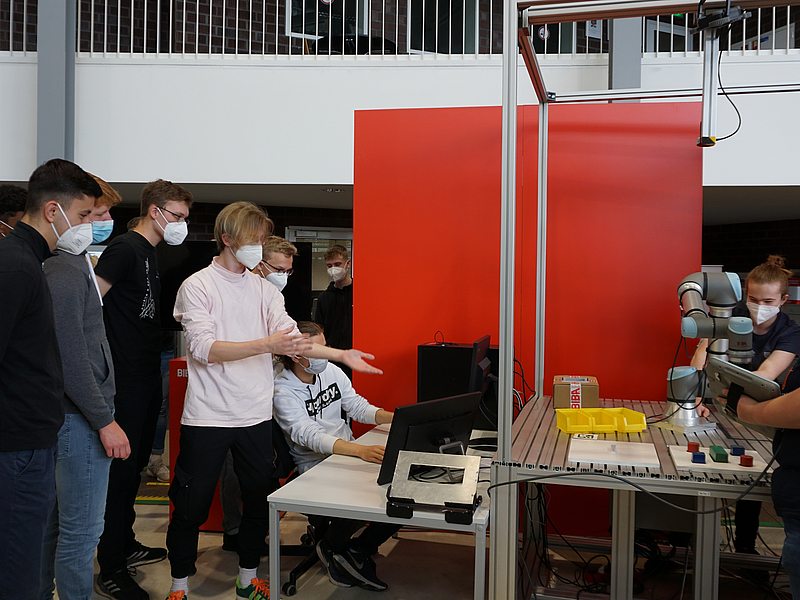
This cooperation also has the prospect of being continued. As early as 2019, Professor Michael Freitag from the BIBA – Bremer Institut für Produktion und Logistik contacted the Beruflichen Gymnasium der Berufsbildenden Schulen Osterholz-Scharmbeck (BBS OHZ) and initiated a collaboration. After a two-year pandemic-induced break, two groups of students from a 12th grade class tackled an engineering assignment in their project phase this spring. The task was to use a microcontroller (single-chip microcomputer) to visualize the working status of a robot via LED light bar and to present the project results.

“The perfect assignment for a class focusing on ‘mechatronics’ – and a perfect fit to coincide with the second semester of the Berufliches Gymnasium Technik,” Bernd Hollermann, teacher at the BBS OHZ, happily reports. It was a great challenge for and also an additional burden on his students, but they all enthusiastically participated throughout. This is confirmed by Lennart Rolfs, the BIBA scientist supervising the project: “It went surprisingly well. I didn’t expect such a high level of engagement, nor did I expect such a high level of understanding of the process.”

“It was a most interesting and informative phase, which we plan to repeat and possibly continue in greater depth in technology classes,” says Hollermann. Michael Freitag on continues: “We consider the project a success and are happy to be involved again. BIBA is supporting the University of Bremen with ‘research-based learning’ and ‘project studies.’ Practical experience is of very high priority in our work.”

Sabine Nollmann


Additional Information:

www.fb4.uni-bremen.de/studiumprotect me ?!.html
www.uni-bremen.de/en


Contact:

Thomas Bruns
University of Bremen | Faculty of Production Engineering
Study Center
Tel.: +49 421 218-64 997
Email: thbrunsprotect me ?!uni-bremenprotect me ?!.de

Svenja Schell 
University of Bremen | Faculty of Production Engineering 
Study Center 
Tel.: +49 421 218-64 998
Email: svenja.schellprotect me ?!uni-bremenprotect me ?!.de
 

Schulklasse
With the help of a microcontroller, students from the Berufliches Gymnasium Technik visualized the work status of a robot with an LED light bar.

Events

05. Aug
Studentische Forschungswerkstatt: Perspektiven auf indigene Sprachen in sozialen Medien
GW2, B3.010
09:30 15:00
More
17. Aug
Bernsteine: Zeitkapseln der Evolution
Hanse-Wissenschaftskolleg, Lehmkuhlenbusch 4, 27753 Delmenhorst
19:30 21:00
More
24.04. Aug Sep
29. Informatica Feminale
Campus der Uni Bremen
All day
More
26. Aug
Online Event: Transition from Bachelor's to Master's degree program
Zoom
14:00 16:00
More
02. Sep
Online-Veranstaltung zum Übergang vom Bachelor ins Master-Studium
Zoom
14:00 16:00
More
03. Sep
Warum wir wählen, was wir wählen: Unser Wahlverhalten in unsicheren Zeiten
VHS Delmenhorst, Am Turbinenhaus11, 27749 Delmenhorst
19:30 21:00
More
08. Sep
20 Jahre Kriseninterventionsteam Stalking (Stalking-KIT) in Bremen
Forum am Domshof
10:00 17:00
More
09.11. Sep
Integrated Training on "Place" in Global Health: From Geospatial Methods to Positionality
Johannes Gutenberg-University Mainz (Campus), 55128 Mainz
All day
More
05. Oct
Wahlmanipulation im digitalen Zeitalter: Wo liegen die Gefahren?
Hanse-Wissenschaftskolleg, Lehmkuhlenbusch 4, 27753 Delmenhorst
19:30 21:00
More
29. Oct
Prof. Dr. Michèle Heurs (Uni Hannover und DESY/DZA): Titel folgt
Hörsaal H3, Geb. NW1, Otto-Hahn-Allee 1, 28359 Bremen
16:00 17:00
More
02. Nov
Wölfe in Niedersachsen
Hanse-Wissenschaftskolleg, Lehmkuhlenbusch 4, 27753 Delmenhorst
19:30 21:00
More
06. Nov
M.Ed. - Absolventenfeier des Lehramts
Großer Saal im Hörsaalgebäude (HS 2010)
17:00 19:30
More
12. Nov
Info-Veranstaltung: Studieren in Bremen und Bremerhaven
Zoom
16:00 18:00
More
12. Nov
Dr. Martin Eckstein (Universität Hamburg): Titel folgt
Hörsaal H3, Geb. NW1, Otto-Hahn-Allee 1, 28359 Bremen
16:00 17:00
More
26. Nov
Prof. Dr. Rafaela Hillerbrand (Karlsruhe Institute of Technology): Dual Use, Risk, and Responsibility in Physical Research - Abgesagt!
Hörsaal H3, Geb. NW1, Otto-Hahn-Allee 1, 28359 Bremen
16:00 17:00
More
14. Jan
Prof. Dr. Kristina Giesel (FAU Erlangen-Nürnberg): Titel folgt
Hörsaal H3, Geb. NW1, Otto-Hahn-Allee 1, 28359 Bremen
16:00 17:00
More
All Events

Studies

Students walking along the MZH and chatting

Studying at the University of Bremen

Whether it be the compact campus, the diverse study programs on offer, or the green cycling city – a degree at the University of Bremen has a lot to offer.

You can choose from a broad range of degree program at the University of Bremen:

  • more than 100 bachelor’s and master’s degree programs
  • the state examination in law
  • international degree courses and further training offers

Profile

The University of Bremen is one of Germany’s medium-sized universities. In its mission statement, the university prioritizes:

Academic Consultation

Visit the following points of contact for information on studying:

Applying to Study

We provide comprehensive and detailed information on applications and enrollment for the following areas:

All about Research

Test tubes with different coloured liquids.

High Level of Third-Party Funding

A great strength of the University of Bremen is its considerable success in the acquisition of third-party funds, both in individual as well as in collaborative research. The German Research Foundation (DFG) is the largest provider of third-party finance: Besides the MARUM Cluster of Excellence, the University of Bremen is currently involved in no less than seven Collaborative Research Centers, as well as a number of research groups and priority programs.

Zwei Personen bei der gemeinsamen Arbeit im Labor.

Strategic Promotion of Talent

The targeted promotion of young talent, unlocking potential, and early independence are among the guiding principles of the University of Bremen. We offer intensive support to young academics in six DFG research training groups, numerous junior research groups and also through doctoral programs offered in cooperation with non-university research institutions.

Zwei Lehrende arbeiten vor Zuhörern an einem Flipchart.

Lifelong Learning

The University of Bremen is a place of lifelong learning. With our offers of continuing education we enable you to acquire knowledge of cutting-edge research. Discover the wide range of our offers and benefit from the unique combination of practice-oriented learning and innovation.

Facets of the University of Bremen

Diversity

The diversity of our students and staff is both a framework as well as a prerequisite for high quality in research and teaching. As a cross-sectional priority and central profiling feature, we take account of diversity in our teaching and learning formats, in the structure of degree programs, and in the content of research and teaching. Moreover, diversity orientation and equal opportunity also guide us in the composition of teams and the design of counseling.   

International

Internationality is a strategic profiling objective of the University of Bremen. In keeping with our self-image as an international university, we see internationalization as a process that extends into all areas of the university – whether research, studies or administration. People from more than 100 nations enrich campus life. We are networked worldwide. In close cooperation with our partners, we work on the advancement of knowledge and finding solutions to global challenges.

Sustainability

The University of Bremen has been committed to sustainable development for years. Numerous projects and measures exist in the areas of research, teaching, operations, governance, and transfer, supporting the implementation of the 17 Sustainable Development Goals (SDGs) by the United Nations. Among them are the outstanding EMAS environmental management program, the university’s promotion of social sustainability as well as several research institutions with a focus on sustainability

Have you Heard of...?

There is a lot to be discovered on campus. What’s behind all those doors? up2date. online magazine knocks on some of them to find out. Welcome to a slightly different tour of the campus.

A man in front of a green screen is looking into the camera.

Have You Heard of... the ZMML?

Learning platform, testing center, online courses, lecture halls with opencast technology, a film studio, and much more – when you see digital teaching in action on campus, the ZMML is usually behind it.

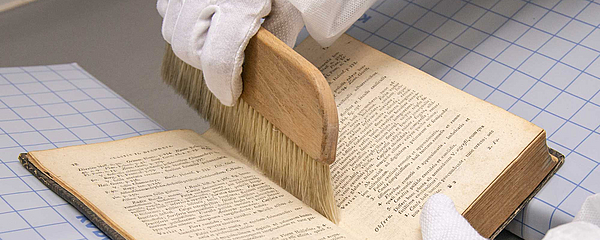
A gloved hand runs a brush through the crease of a book.

Have You Heard of... the SuUB’s Restoration Workshop?

Equipped with an array of tools that includes brushes, book support wedges, and soot sponges, the restoration workshop saves historical books from decay. Welcome to a slightly different tour of the campus!