Homepage

News

Training Students to Become Systemic Coaches

Currently, 40 students of the Business Psychology master’s program are undergoing coaching training. After passing the examination, five of them received their certificates at the founding ceremony of the Institute for Sustainability Coaching on 24 February.

Coaching training is a free additional offer for students in the Business Psychology master’s program. Over three semesters, the recently certified students have undergone coaching training while pursuing their degrees. In doing so, they learned the approaches and methods of systemic coaching and were able to apply them. The training aims to qualify them to use their perspectives as members of Generation Z to assist other (young) people with their individual concerns. Central goals of coaching can be to work on decision-making and action-taking skills, to strengthen and maintain performance capabilities, and to develop self-management skills.

Georg Müller-Christ, a sustainable management professor, initiated the training together with the psychologist PD Dr. Iris Stahlke and the research assistant Lisa-Marie Seyfried. The University of Bremen’s team designed the program with experts from the European Association for Supervision and Coaching (EASC). EASC is a European coaching association that develops guidelines for training coaches and reviews their implementation.

Institute for Sustainability Coaching Founded

The students received their certificates as part of the founding ceremony of the Institute for Sustainability Coaching at the University of Bremen. The research institute is headed by Georg Müller-Christ and Iris Stahlke. It pursues the goal of developing the concept of sustainability coaching for decision-makers, leaders, teachers, and students. “Coaching usually takes place as part of a two-person relationship, in which the coach helps the coachee to identify and achieve their own goals,” says Georg Müller-Christ. Sustainability coaching is about taking into account not only individual but also community goals such as sustainability and equity. Incorporating such considerations might make decisions more complex and can lead to dilemmas and higher trade-off costs. This is another reason why sustainability considerations rarely occur in traditional coaching.

“The coaching training for students, which will begin every winter semester in the future, is the first service the institute has developed,” says Iris Stahlke. The institute’s team is currently working on other formats, such as networking meetings and training days for coaches.

Further Information:

https://www.uni-bremen.de/inc (in German only)

Contact:

Prof. Dr. Georg Müller-Christ
Institute for Sustainability Coaching
Phone: +49 421 218-66780
Email: gmcprotect me ?!uni-bremenprotect me ?!.de
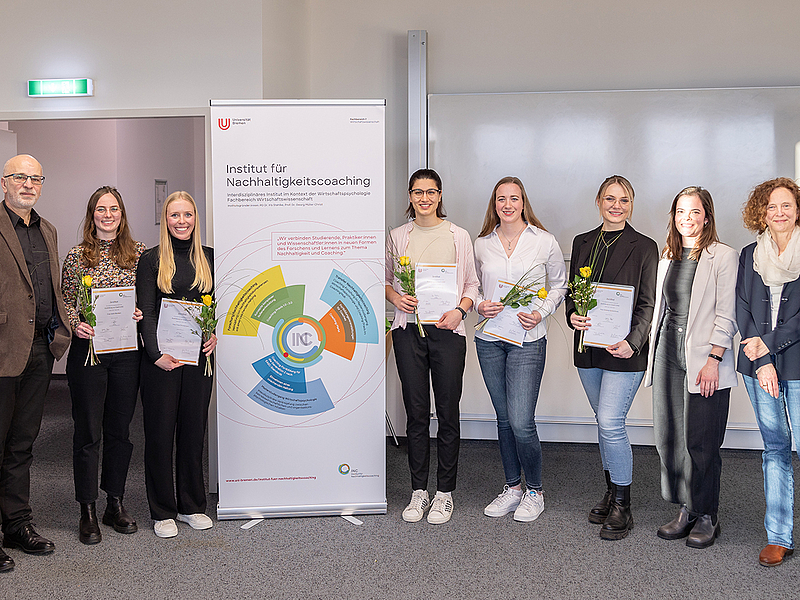
 

The graduates of the coaching training with Georg Müller-Christ (left), Iris Stahlke (right) and Lisa-Marie Seyfried (second from right).

Events

29. Jun
Civil War Anxiety in Russian: Political Emotions from Perestroika to the “Wild Nineties”
IW3 0330
18:15 19:45
More
29. Jun
Untergrundschulen für Mädchen in Afghanistan - Let Her Learn
Studierhaus SH D1020
18:15 19:45
More
29. Jun
Mit Spielmaterialien und Kinderbüchern Diversität reflektieren: Perspektiven für Kindertageseinrichtungen
Haus der Wissenschaft, Kleiner Saal, Sandstraße 4/5, 28195 Bremen
19:00 21:00
More
30. Jun
Mittagskonzert: Im Zauber der Klänge: Klaviermusik von Klassik bis Filmmusik
Theatersaal der Universität
12:30 12:55
More
30. Jun
Thiago Barbosa (Leipzig) "Lithium Extractivism and Indigenous (Un)futurism in Brazil."
Universität Bremen, GW2 B1216
16:15 18:00
More
30. Jun
„Versäumte Bilder“ – Ausstellung und Public Lecture im Forum am Domshof
Forum am Domshof
18:00 19:30
More
30. Jun
Lesung mit Sharon Dodua Otoo zu ihrem neuen Roman "So, in etwa, ist es geschehen"
Weserburg
18:00 20:00
More
06. Jul
Auf dem Weg zu einem „gemeinsamen europäischen Haus“? Der Boom der westdeutsch-sowjetischen Städtepartnerschaften in der Perestrojka
IW3 0330
18:15 19:45
More
07. Jul
Mittagskonzert: Trio Ata la Taba – Argentinische Folklore
Theatersaal der Universität
12:30 12:55
More
07. Jul
„Versäumte Bilder“ – Ausstellung und Public Lecture im Forum am Domshof
Forum am Domshof
18:00 19:30
More
08. Jul
Katrin Antweiler (Uni Bremen, IfEK), "Memory Politics in International Cultural Relations: Insights from a case study on German mnemonic engagement in South African"
UNICOM, 7.2210
12:00 13:30
More
09. Jul
Martian Mindset Seminar: Psychological Challenges and Collaboration in Long-Duration Spaceflight
AIB
14:15 16:00
More
09. Jul
Dr. Giuseppe Romano (MIT-IBM Watson AI Laboratory): Titel folgt
Hörsaal H3, Geb. NW1, Otto-Hahn-Allee 1, 28359 Bremen
16:00 17:00
More
17. Aug
Bernsteine: Zeitkapseln der Evolution
Hanse-Wissenschaftskolleg, Lehmkuhlenbusch 4, 27753 Delmenhorst
19:30 21:00
More
03. Sep
Warum wir wählen, was wir wählen: Unser Wahlverhalten in unsicheren Zeiten
VHS Delmenhorst, Am Turbinenhaus11, 27749 Delmenhorst
19:30 21:00
More
08. Sep
20 Jahre Kriseninterventionsteam Stalking (Stalking-KIT) in Bremen
Forum am Domshof
10:00 17:00
More
09.11. Sep
Integrated Training on "Place" in Global Health: From Geospatial Methods to Positionality
Johannes Gutenberg-University Mainz (Campus), 55128 Mainz
All day
More
05. Oct
Wahlmanipulation im digitalen Zeitalter: Wo liegen die Gefahren?
Hanse-Wissenschaftskolleg, Lehmkuhlenbusch 4, 27753 Delmenhorst
19:30 21:00
More
29. Oct
Prof. Dr. Michèle Heurs (Uni Hannover und DESY/DZA): Titel folgt
Hörsaal H3, Geb. NW1, Otto-Hahn-Allee 1, 28359 Bremen
16:00 17:00
More
02. Nov
Wölfe in Niedersachsen
Hanse-Wissenschaftskolleg, Lehmkuhlenbusch 4, 27753 Delmenhorst
19:30 21:00
More
06. Nov
M.Ed. - Absolventenfeier des Lehramts
Großer Saal im Hörsaalgebäude (HS 2010)
17:00 19:30
More
12. Nov
Info-Veranstaltung: Studieren in Bremen und Bremerhaven
Zoom
16:00 18:00
More
12. Nov
Dr. Martin Eckstein (Universität Hamburg): Titel folgt
Hörsaal H3, Geb. NW1, Otto-Hahn-Allee 1, 28359 Bremen
16:00 17:00
More
26. Nov
Prof. Dr. Rafaela Hillerbrand (Karlsruhe Institute of Technology): Dual Use, Risk, and Responsibility in Physical Research - Abgesagt!
Hörsaal H3, Geb. NW1, Otto-Hahn-Allee 1, 28359 Bremen
16:00 17:00
More
14. Jan
Prof. Dr. Kristina Giesel (FAU Erlangen-Nürnberg): Titel folgt
Hörsaal H3, Geb. NW1, Otto-Hahn-Allee 1, 28359 Bremen
16:00 17:00
More
All Events

Studies

Students walking along the MZH and chatting

Studying at the University of Bremen

Whether it be the compact campus, the diverse study programs on offer, or the green cycling city – a degree at the University of Bremen has a lot to offer.

You can choose from a broad range of degree program at the University of Bremen:

  • more than 100 bachelor’s and master’s degree programs
  • the state examination in law
  • international degree courses and further training offers

Profile

The University of Bremen is one of Germany’s medium-sized universities. In its mission statement, the university prioritizes:

Academic Consultation

Visit the following points of contact for information on studying:

Applying to Study

We provide comprehensive and detailed information on applications and enrollment for the following areas:

All about Research

Test tubes with different coloured liquids.

High Level of Third-Party Funding

A great strength of the University of Bremen is its considerable success in the acquisition of third-party funds, both in individual as well as in collaborative research. The German Research Foundation (DFG) is the largest provider of third-party finance: Besides the MARUM Cluster of Excellence, the University of Bremen is currently involved in no less than seven Collaborative Research Centers, as well as a number of research groups and priority programs.

Zwei Personen bei der gemeinsamen Arbeit im Labor.

Strategic Promotion of Talent

The targeted promotion of young talent, unlocking potential, and early independence are among the guiding principles of the University of Bremen. We offer intensive support to young academics in six DFG research training groups, numerous junior research groups and also through doctoral programs offered in cooperation with non-university research institutions.

Zwei Lehrende arbeiten vor Zuhörern an einem Flipchart.

Lifelong Learning

The University of Bremen is a place of lifelong learning. With our offers of continuing education we enable you to acquire knowledge of cutting-edge research. Discover the wide range of our offers and benefit from the unique combination of practice-oriented learning and innovation.

Facets of the University of Bremen

Diversity

The diversity of our students and staff is both a framework as well as a prerequisite for high quality in research and teaching. As a cross-sectional priority and central profiling feature, we take account of diversity in our teaching and learning formats, in the structure of degree programs, and in the content of research and teaching. Moreover, diversity orientation and equal opportunity also guide us in the composition of teams and the design of counseling.   

International

Internationality is a strategic profiling objective of the University of Bremen. In keeping with our self-image as an international university, we see internationalization as a process that extends into all areas of the university – whether research, studies or administration. People from more than 100 nations enrich campus life. We are networked worldwide. In close cooperation with our partners, we work on the advancement of knowledge and finding solutions to global challenges.

Sustainability

The University of Bremen has been committed to sustainable development for years. Numerous projects and measures exist in the areas of research, teaching, operations, governance, and transfer, supporting the implementation of the 17 Sustainable Development Goals (SDGs) by the United Nations. Among them are the outstanding EMAS environmental management program, the university’s promotion of social sustainability as well as several research institutions with a focus on sustainability

Have you Heard of...?

There is a lot to be discovered on campus. What’s behind all those doors? up2date. online magazine knocks on some of them to find out. Welcome to a slightly different tour of the campus.

A man in front of a green screen is looking into the camera.

Have You Heard of... the ZMML?

Learning platform, testing center, online courses, lecture halls with opencast technology, a film studio, and much more – when you see digital teaching in action on campus, the ZMML is usually behind it.

A gloved hand runs a brush through the crease of a book.

Have You Heard of... the SuUB’s Restoration Workshop?

Equipped with an array of tools that includes brushes, book support wedges, and soot sponges, the restoration workshop saves historical books from decay. Welcome to a slightly different tour of the campus!